


AI-AUGMENTED JUDICIAL RELATIVITY FRAMEWORK (JRF) AN EXPLAINABLE, DIMENSIONALITY-REDUCING DECISION-SUPPORT METHODOLOGY FOR AUGMENTED JUSTICE
- Chief Learning Officer, ML360 Educations Pvt. Ltd., India.B.Tech (Bioinformatics, VIT University); CFA (ICFAI); Applied Machine Learning (Columbia University).
4 Downloads
242 Views

Abstract
Modern judicial systems must synthesize numerous interconnected variables — statutory provisions, factual evidence, intent, witness credibility, forensic findings, constitutional principles, and historical precedent — while remaining consistent and unbiased. This paper proposes the Judicial Relativity Framework (JRF), an AI-assisted decision-support methodology inspired by Einstein\'s concept of multiple frames of reference and by dimensionality-reduction principles from machine learning. JRF transforms a complex legal problem into a small number of interpretable decision dimensions — factual certainty, legal similarity, ethical impact, constitutional compatibility, and precedent consistency — without replacing judicial discretion. It combines explainable artificial intelligence, legal knowledge graphs, semantic precedent retrieval, causal inference, and evidence weighting to produce a transparent judicial-assistance report; its dimensionality-reduction, semantic-embedding, contradiction-detection, precedent-retrieval, and explainable-attribution components are given a full mathematical formalization, so every quantitative claim is precisely defined rather than merely illustrated. The resulting judicial dimensions are exact, traceable linear combinations of the underlying evidentiary features, and their contributing evidence can be recovered through an exact Shapley-value decomposition. Two illustrative case studies — a property-ownership dispute and a fatal road accident — show that the same architecture and mathematics generalize across areas of law, while judges retain complete authority over the final verdict. By reframing legal disputes as a small set of interpretable, mathematically grounded dimensions rather than a mass of correlated variables, JRF offers augmented rather than automated justice, improving consistency and transparency subject to fairness, explainability, and due-process safeguards. The framework remains a conceptual and mathematical proposal; empirical validation is identified as necessary future work.
Keywords
How to Cite This Article
Prabhat Kumar (2026); AI-AUGMENTED JUDICIAL RELATIVITY FRAMEWORK (JRF) AN EXPLAINABLE, DIMENSIONALITY-REDUCING DECISION-SUPPORT METHODOLOGY FOR AUGMENTED JUSTICE, International Journal of Advanced Research (IJAR), 14 (08), 121-134, ISSN 2320-5407. DOI: https://doi.org/10.21474/IJAR01/23944
Corresponding Author
Publication Achievement
Publication card
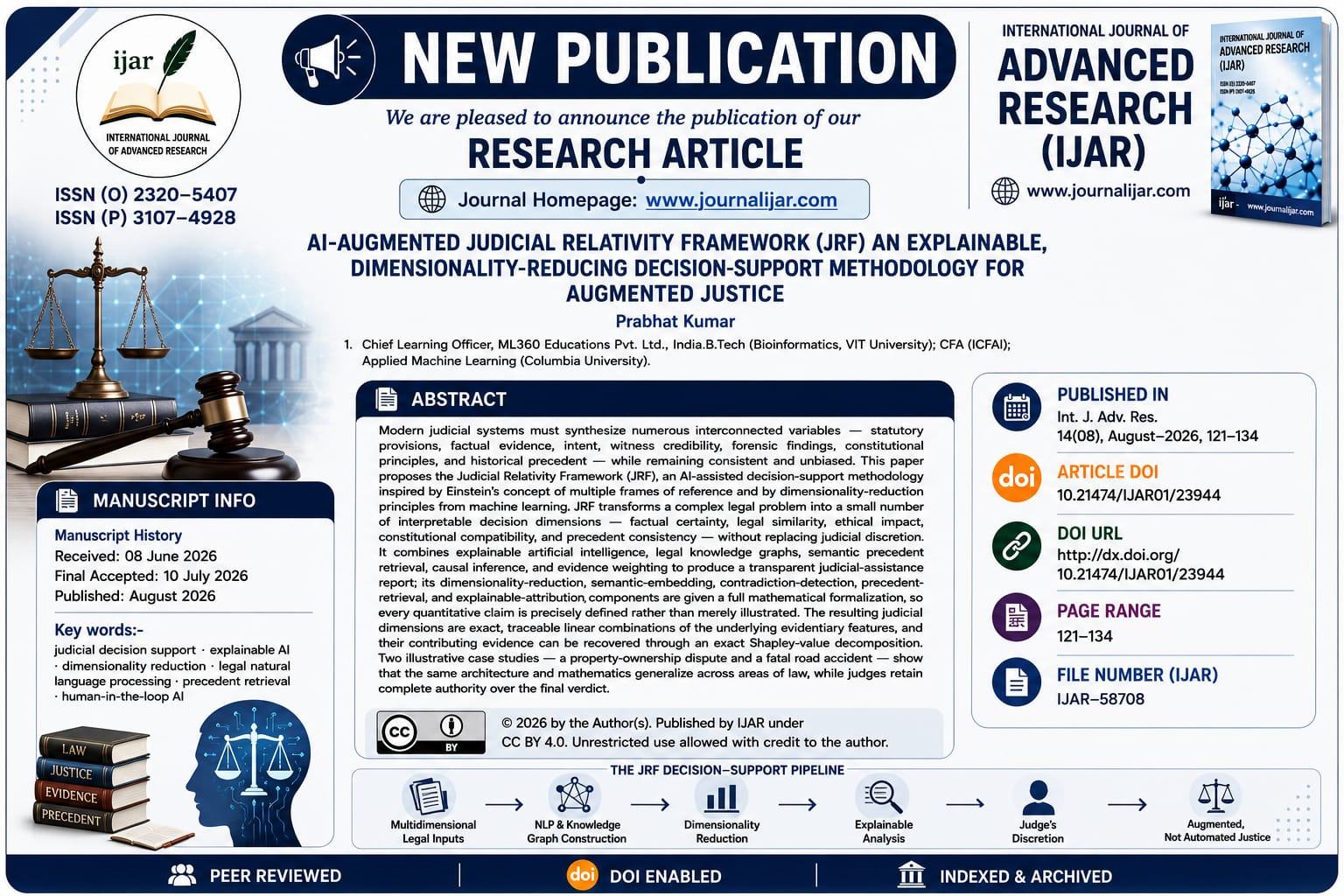
🎉 Proud to contribute to scientific research! Share your publication with your colleagues and professional network.
Article Analytics
Similar Articles
1
947
8
231
4
276
1
165
8
197
 This work is licensed under a Creative Commons Attribution 4.0 International License.