


ROLE OF UMBILICAL BLOOD CULTURE IN DETECTION OF EARLY ONSET SEPSIS IN HIGH-RISK NEONATES
- Department of Pediatrics, School of Medical Sciences & Research, Sharda University, Greater Noida, Uttar Pradesh, India.
- Department of Pediatrics, Noida Institute of Medical Science, Greater Noida, Uttar Pradesh, India.
0 Downloads
0 Views
Abstract
Background: This prospective observational investigation evaluated the clinical diagnostic precision of Umbilical Cord Blood Culture (UCBC)in comparison with the standard reference technique,Peripheral Vein Blood Culture (PVBC), for isolating Early-Onset Neonatal Sepsis (EONS) among newborns exhibiting maternal high-risk indicators.
Materials and Methods: Pair-matched blood samplings were gathered under meticulous aseptic guidelines directly from the umbilical cord at delivery and via standard peripheral venipuncture upon admission to the neonatal intensive care unit (NICU). The evaluation examined 72 high-risk infants monitored at Sharda Hospital, Greater Noida. Key validity criteria including sensitivity, specificity, positive predictive value (PPV), and negative predictive value (NPV) were calculated.
Keywords
How to Cite This Article
Dhavel Kumar Srivastav et, al (2026); ROLE OF UMBILICAL BLOOD CULTURE IN DETECTION OF EARLY ONSET SEPSIS IN HIGH-RISK NEONATES, International Journal of Advanced Research (IJAR), 14 (08), 341-345, ISSN 2320-5407.
Corresponding Author
Publication Achievement
Publication card
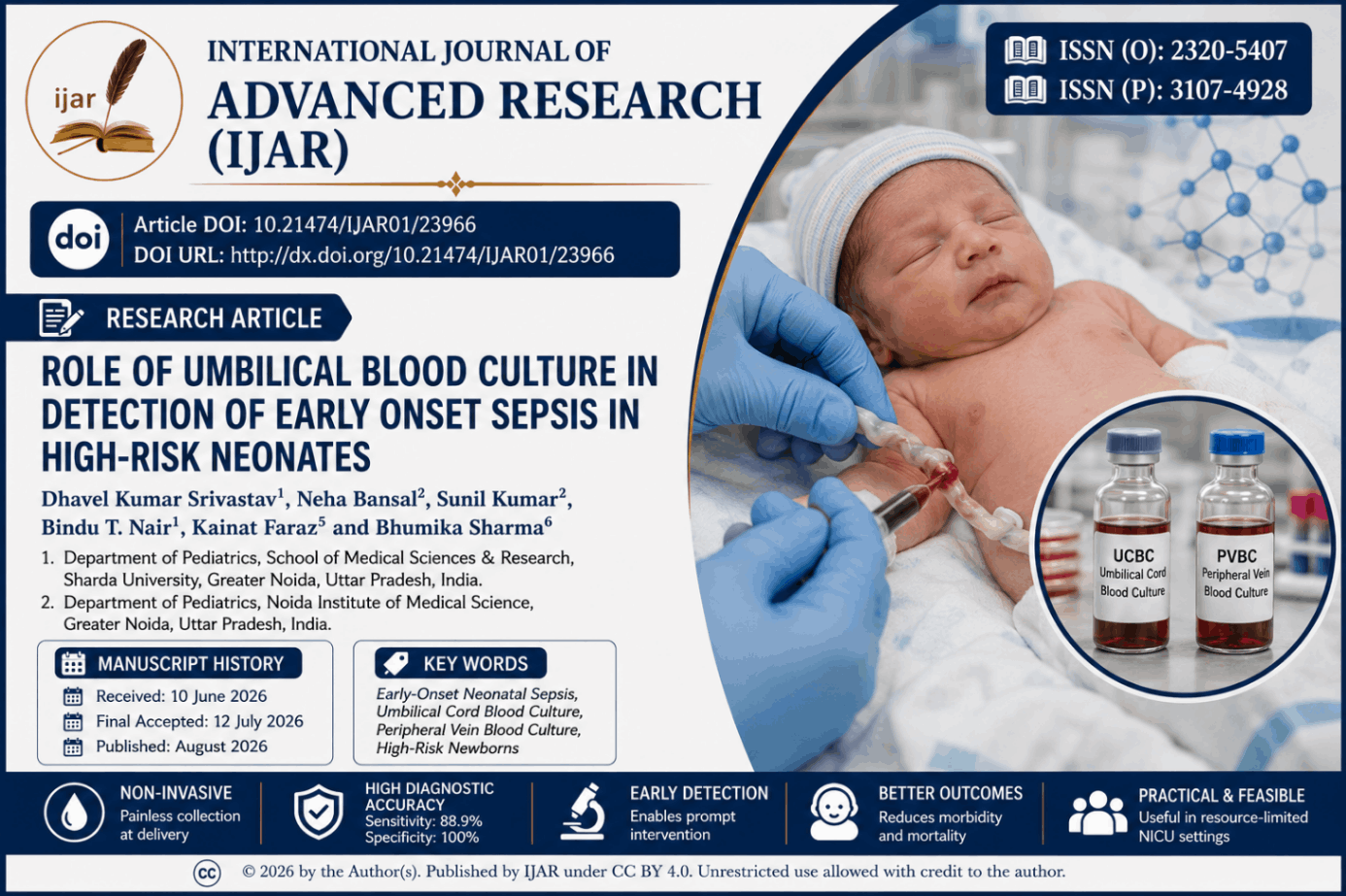
🎉 Proud to contribute to scientific research! Share your publication with your colleagues and professional network.
 This work is licensed under a Creative Commons Attribution 4.0 International License.