


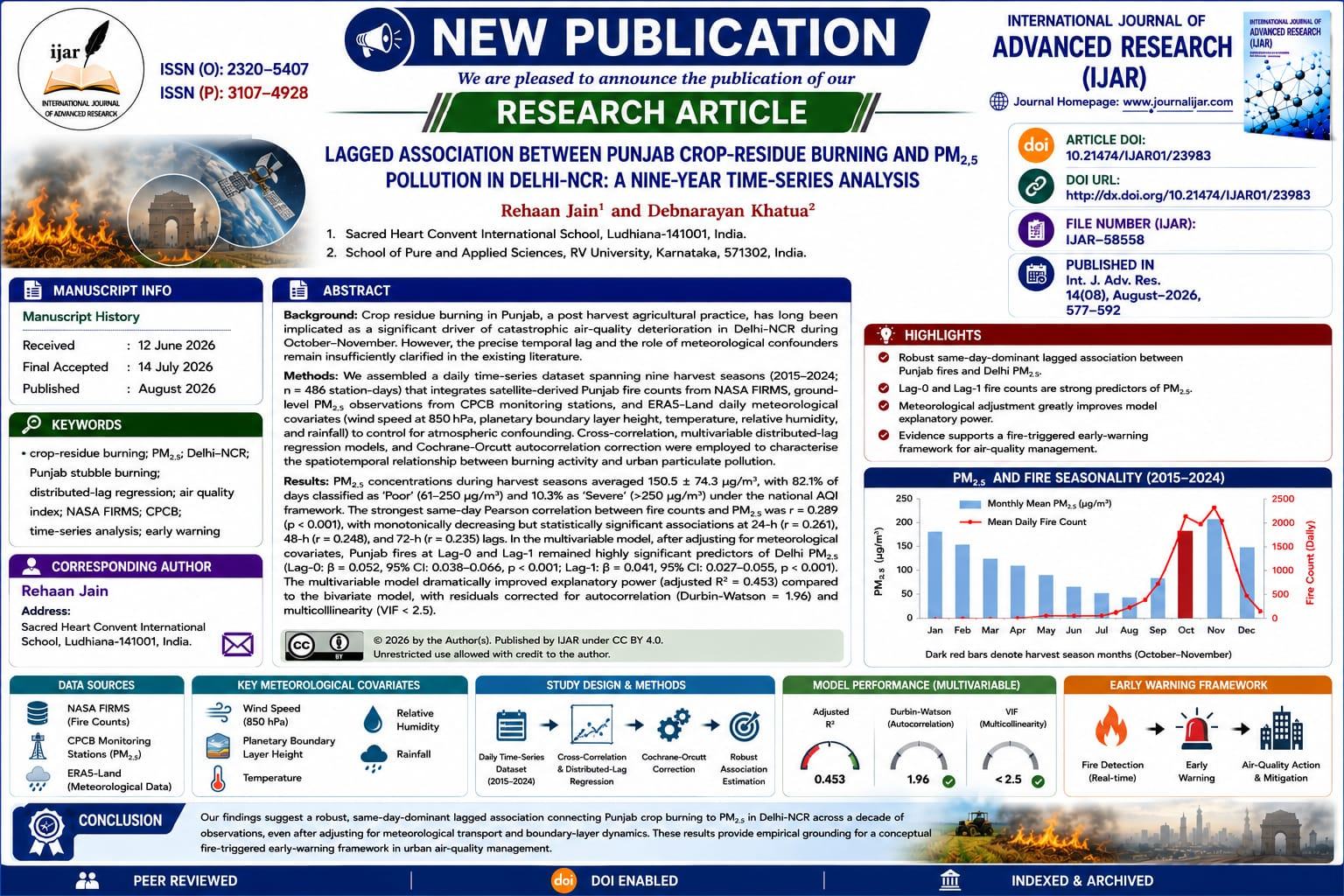
LAGGED ASSOCIATION BETWEEN PUNJAB CROP-RESIDUE BURNING AND PM 2.5 POLLUTION IN DELHI-NCR: A NINE-YEAR TIME-SERIES ANALYSIS
- Sacred Heart Convent International School, Ludhiana-141001, India.
- School of Pure and Applied Sciences, RV University, Karnataka, 571302, India.
1 Downloads
175 Views

Abstract
Background: Crop residue burning in Punjab, a post harvest agricultural practice, has long been implicated as a significant driver of catastrophic air-quality deterioration in Delhi-NCR during October -November. However, the precise temporal lag and the role of meteorological confounders remain insufficiently clarified in the existing literature. Methods: We assembled a daily time-series dataset spanning nine harvest seasons (2015 - 2024; n = 486 station- days) that integrates satellite-derived Punjab fire counts from NASA FIRMS, ground-level PM2.5 observations from CPCB monitoring stations, and ERA5-Land daily meteorological covariates (wind speed at 850 hPa, planetary boundary layer height, temperature, relative humidity, and rainfall) to control for atmospheric confounding. Cross-correlation, multivariable distributed-lag regression models, and Cochrane-Orcutt autocorrelation correction were employed to characterise the spatiotemporal relationship between burning activity and urban particulate pollution.
Keywords
How to Cite This Article
Rehaan Jain (2026); LAGGED ASSOCIATION BETWEEN PUNJAB CROP-RESIDUE BURNING AND PM 2.5 POLLUTION IN DELHI-NCR: A NINE-YEAR TIME-SERIES ANALYSIS, International Journal of Advanced Research (IJAR), 14 (08), 577-592, ISSN 2320-5407. DOI: https://doi.org/10.21474/IJAR01/23983
Corresponding Author
Publication Achievement
Publication card
🎉 Proud to contribute to scientific research! Share your publication with your colleagues and professional network.
Article Analytics
Similar Articles
10
186
60
318
33
217
75
903
163
799
 This work is licensed under a Creative Commons Attribution 4.0 International License.