


ELECTED BY WHOM? AMBEDKAR, SEPARATE ELECTORATES, AND THE PRINCIPLE OF GROUP AUTHORIZATION
- Research Scholar at Vikrant University.
3 Downloads
348 Views

Abstract
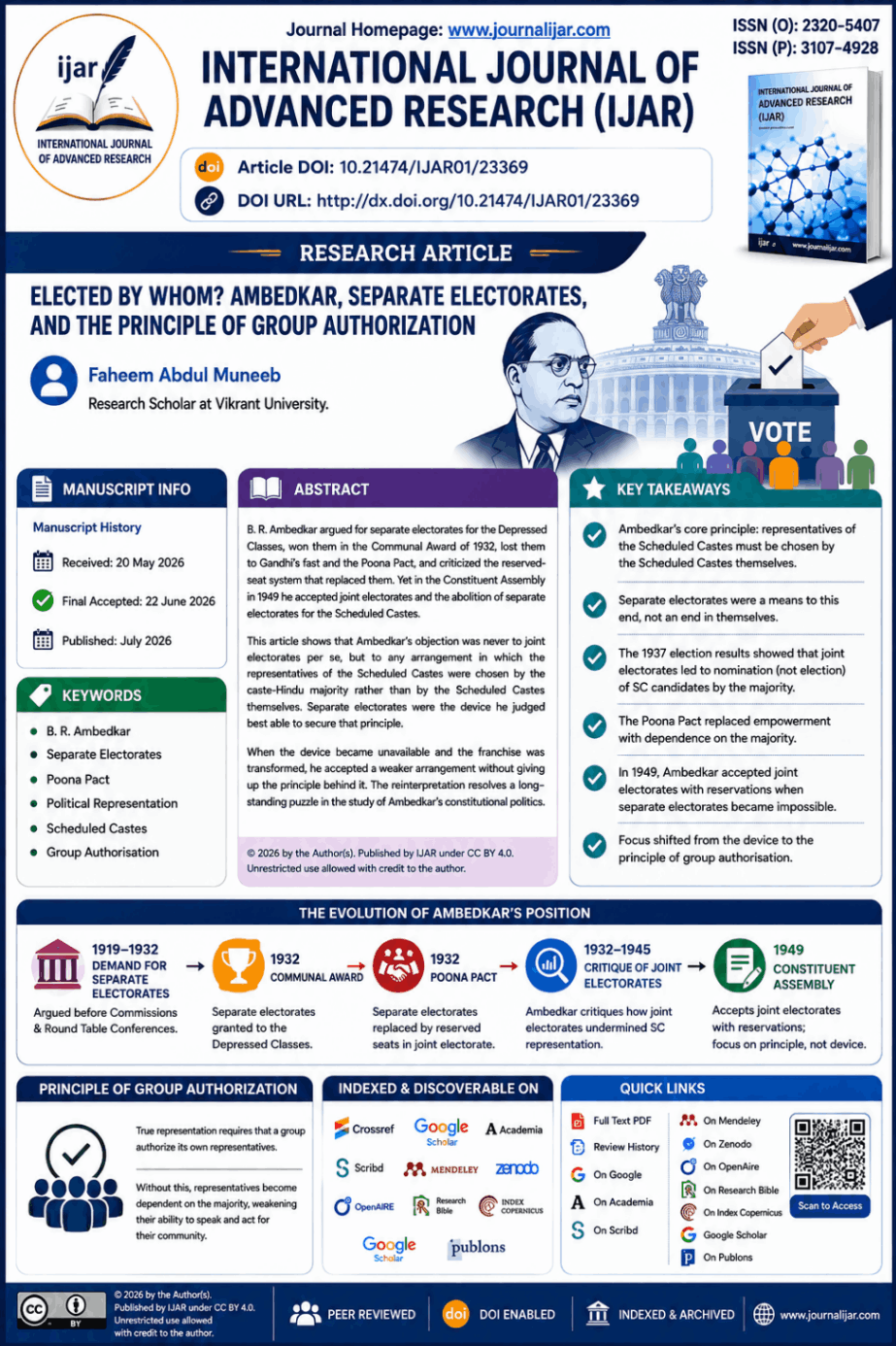
B. R. Ambedkar spent more than a decade arguing for separate electorates for the Depressed Classes. He won them in the Communal Award of 1932, lost them within weeks to Gandhis fast and the Poona Pact, and attacked the reserved-seat system that replaced them for years afterward. Yet in the Constituent Assembly in 1949 he accepted joint electorates and the abolition of separate electorates for the Scheduled Castes. Read as a change of position on the electoral form, this sequence looks like a reverse, a pragmatic compromise, or a change of mind. His electoral writings - the 1930 memorandum to the Round Table Conference, the analysis of the 1937 election returns in What Congress and Gandhi Have Done to the Untouchables, and his interventions in the Constituent Assembly - suggest that the change was one of instrument rather than of principle. His objection to the joint electorate in the Poona Pact period was not to the form alone, but to an arrangement in which the representatives of the Scheduled Castes were chosen by the caste-Hindu majority rather than by the Scheduled Castes themselves. Separate electorates were the device he judged best able to secure representation of that kind under a restricted franchise, and the 1930 memorandum had already made joint electorates acceptable provided they were accompanied by adult suffrage. When universal franchise arrived and separate electorates were no longer available, he accepted a joint electorate while holding to the same commitment.
Keywords
How to Cite This Article
Faheem Abdul Muneeb (2026); ELECTED BY WHOM? AMBEDKAR, SEPARATE ELECTORATES, AND THE PRINCIPLE OF GROUP AUTHORIZATION, International Journal of Advanced Research (IJAR), 14 (07), 1895-1901, ISSN 2320-5407. DOI: https://doi.org/10.21474/IJAR01/23369
Corresponding Author
Publication Achievement
Publication card
🎉 Proud to contribute to scientific research! Share your publication with your colleagues and professional network.
Article Analytics
Similar Articles
 This work is licensed under a Creative Commons Attribution 4.0 International License.