


UNVEILING ANTIOXIDANT ACTIVITY OF NATIVE FRUITS AND VEGETABLES: AN EXPERIMENTAL APPROACH
- Research Scholar, Bharathi Womens College, Chennai, Tamilnadu, India.
- Research Scholar, Bharathi Womens College, Chennai, Tamilnadu, India.
- Research Scholar, Bharathi Womens College, Chennai, Tamilnadu, India.
- Head and Associate Professor for Botany, Bharathi Womens College, Chennai, Tamilnadu India.
2 Downloads
175 Views

Abstract
The present study evaluated the antioxidant potential of selected native fruits,vegetables,and medicinal plant resources through a comprehensive in-vitro experimental approach. Ten plant samples, namely Musa paradisiaca flower and fruit, Solanum torvum, Syzygiumcumini, Pithecellobium dulce, Ficus racemosa, Phyllanthus emblica, Terminalia chebula, Vitis vinifera, and Ziziphus jujuba, were investigated for their free-radical scavenging and reducing capacities. Shade-dried plant materials were extracted and subjected to DPPH radical scavenging, ferric reducing antioxidant power (FRAP), hydrogen peroxide scavenging, superoxide radical scavenging, and nitric oxide scavenging assays. Total phenolic content (TPC) was also determined using the Folin-Ciocalteu method. Considerable variation in antioxidant activity was observed among the investigated samples. In the DPPH assay, Ziziphus jujuba exhibited the highest inhibition (79.75%), followed by Ficus racemosa (78.19%), Pithecellobium dulce (75.70%), and Syzygiumcumini (75.08%). Musa paradisiaca flower showed the highest FRAP activity (75.47%), whereas Ficus racemosa demonstrated the strongest superoxide scavenging activity (79.50%). Hydrogen peroxide scavenging was highest in Musa paradisiaca flower (65.06%), while Phyllanthus emblica exhibited the maximum nitric oxide scavenging activity (60.77%).
Keywords
How to Cite This Article
S.Swathy (2026); UNVEILING ANTIOXIDANT ACTIVITY OF NATIVE FRUITS AND VEGETABLES: AN EXPERIMENTAL APPROACH, International Journal of Advanced Research (IJAR), 14 (08), 762-780, ISSN 2320-5407. DOI: https://doi.org/10.21474/IJAR01/23998
Corresponding Author
Publication Achievement
Publication card
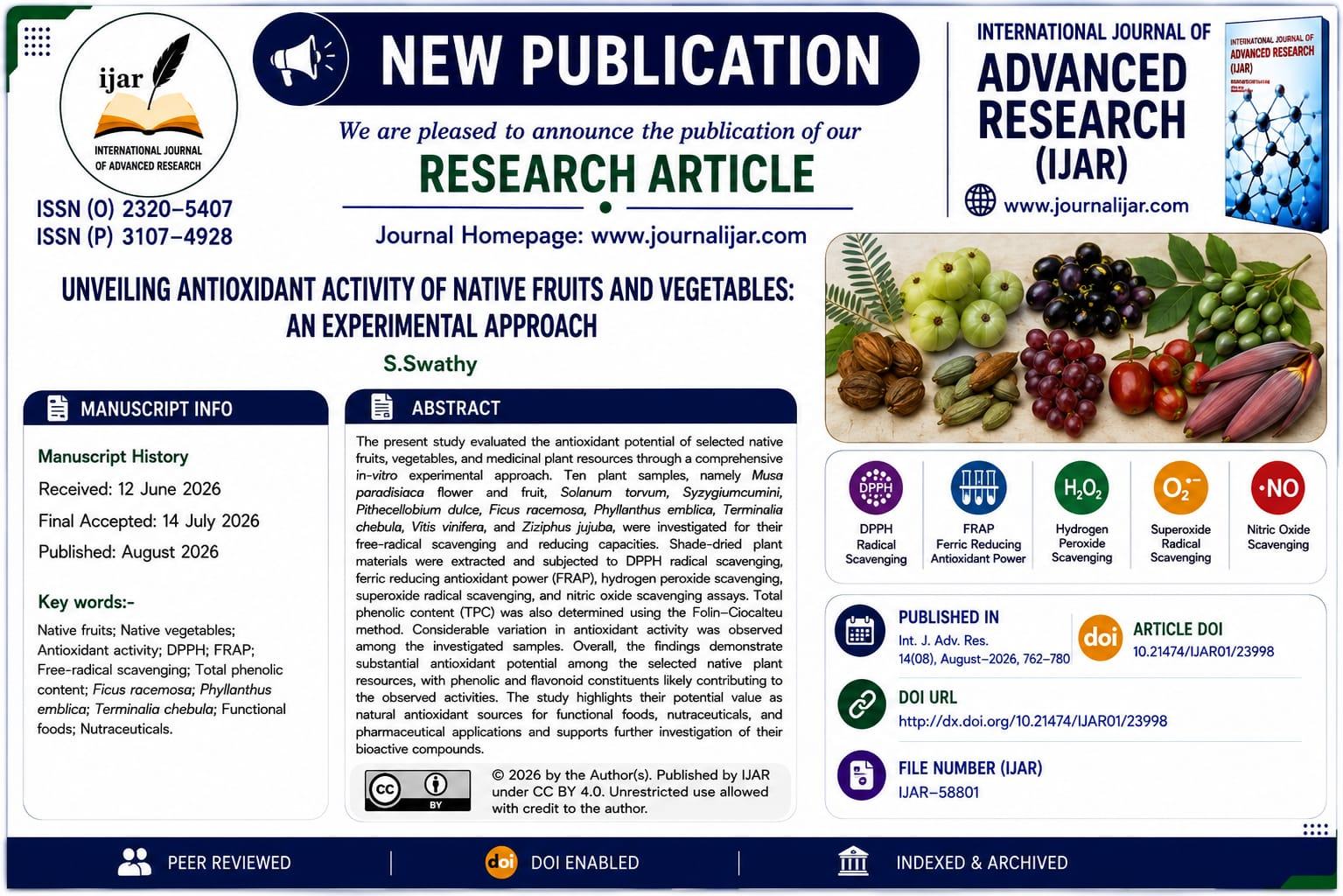
🎉 Proud to contribute to scientific research! Share your publication with your colleagues and professional network.
Article Analytics
Similar Articles
37
235
14
324
24
224
108
537
65
455
 This work is licensed under a Creative Commons Attribution 4.0 International License.