


A CONCEPT OF MULTI-CRITERIA OPTIMIZATION OF GLASS-FIBER COMPOSITES FOR MECHANICAL ENGINEERING
1 Downloads
86 Views

Abstract
The article provides a theoretical foundation for a multi-objective optimisation framework for glass-fibre-reinforced composites used in mechanical engineering structures. The interrelationships among the material,structural, manufacturing,operational,economic,and environmental parameters governing the performance of composite components are examined. A sequence of optimisation procedures is established, encompassing the specification of structural requirements, selection of design variables, formulation of objectives and constraints, numerical modelling, and identification of a set of Pareto-optimal solutions.The necessity of simultaneously considering strength, stiffness,weight, durability, cost, and manufacturability is substantiated. The use of an aggregate performance measure for ranking compromise solutions according to predefined priorities is justified. Particular attention is given to the effects of material-property variability, manufacturing deviations, and operational loads on the robustness of design solutions. The proposed framework combines multi-objective search methods with finite element modelling, sensitivity analysis, and experimental validation. Its implementation enables an informed selection of the composition and reinforcement architecture of glass fibre reinforced composites,taking into account the intended application, manufacturing conditions, and the life cycle of the mechanical engineering structure.
Keywords
How to Cite This Article
Yurii Nadtochii (2026); A CONCEPT OF MULTI-CRITERIA OPTIMIZATION OF GLASS-FIBER COMPOSITES FOR MECHANICAL ENGINEERING, International Journal of Advanced Research (IJAR), 14 (08), 1045-1052, ISSN 2320-5407. DOI: https://doi.org/10.21474/IJAR01/24021
Corresponding Author
Publication Achievement
Publication card
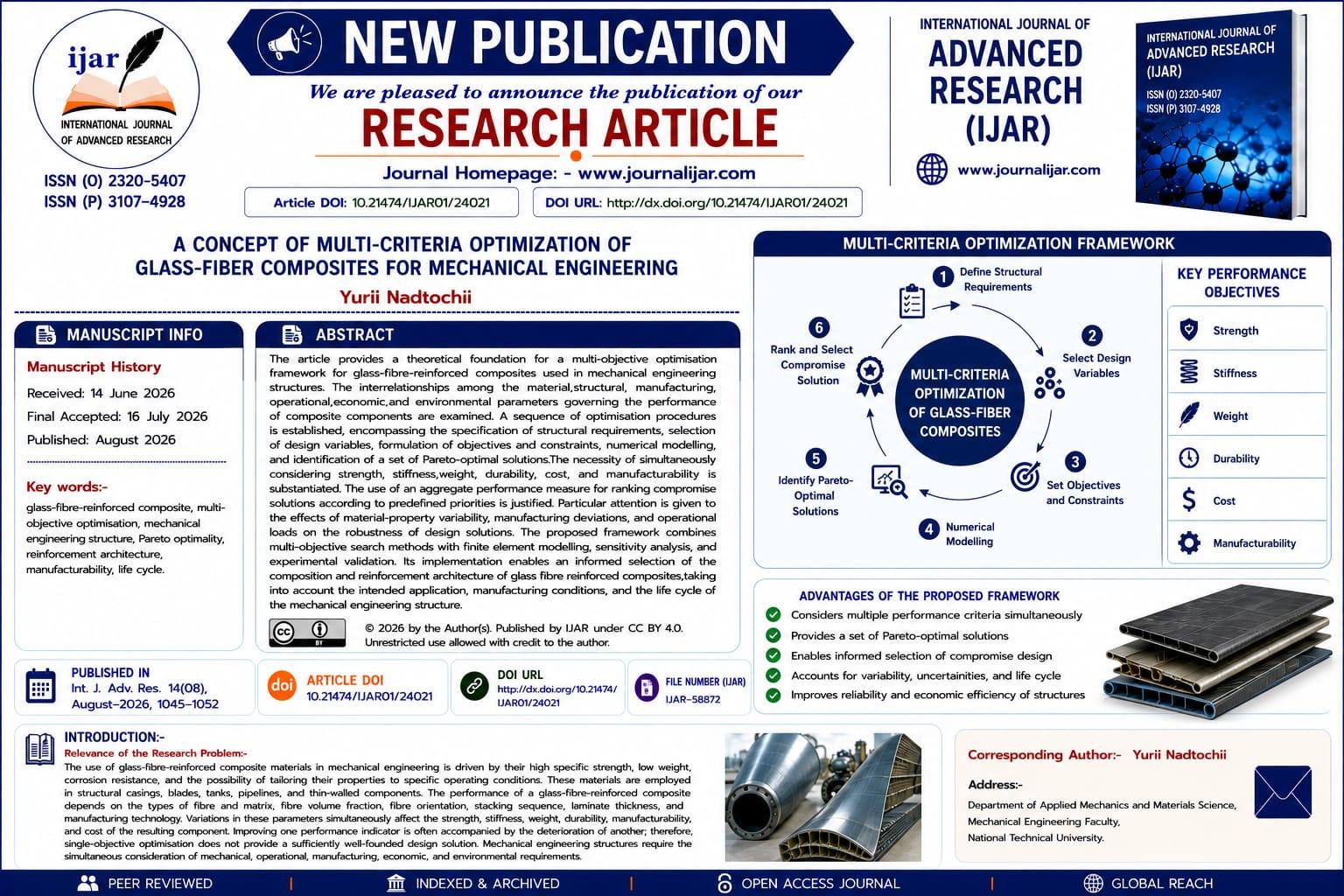
🎉 Proud to contribute to scientific research! Share your publication with your colleagues and professional network.
Article Analytics
Similar Articles
 This work is licensed under a Creative Commons Attribution 4.0 International License.