


CLINICAL SPECTRUM, ETIOLOGICAL PROFILE, AND ANTIFUNGAL SUSCEPTIBILITY PATTERN IN ONYCHOMYCOSIS
- Department of Dermatology, Venereology and Leprosy, Rajkiya Medical College and Hospital, Jalaun, Orai, Uttar Pradesh, India.
- Consultant Radiodiagnosis, Jalaun, Orai, Uttar Pradesh, India.
- Department of Community Medicine, Rajkiya Medical College and Hospital, Jalaun, Orai, Uttar Pradesh, India.
3 Downloads
184 Views

Abstract
Background: Onychomycosis is a common fungal infection of the fingernails and toenails caused by dermatophytes, non-dermatophyte moulds, and yeasts. Accurate clinical and mycological characterization is important for appropriate therapy, especially in view of emerging antifungal resistance. Objective: To study the clinical spectrum of onychomycosis, identify common causative fungal agents, and assess antifungal susceptibility patterns to terbinafine, fluconazole, itraconazole, and griseofulvin. Methods: This descriptive, observational study was conducted in the Dermatology, Venereology and Leprosy outpatient department of Rajkiya Medical College and Hospital, Jalaun, Orai, from November 2022 to October 2023.Patients with clinically suspected onychomycosis and positive direct microscopy were included. Nail specimens were examined using potassium hydroxide microscopy, fungal culture, and organism identification. Antifungal susceptibility was assessed for selected systemic agents.
Keywords
How to Cite This Article
Raghvendra Pratap Singh et, al (2026); CLINICAL SPECTRUM, ETIOLOGICAL PROFILE, AND ANTIFUNGAL SUSCEPTIBILITY PATTERN IN ONYCHOMYCOSIS, International Journal of Advanced Research (IJAR), 14 (08), 981-986, ISSN 2320-5407. DOI: https://doi.org/10.21474/IJAR01/24015
Corresponding Author
Publication Achievement
Publication card
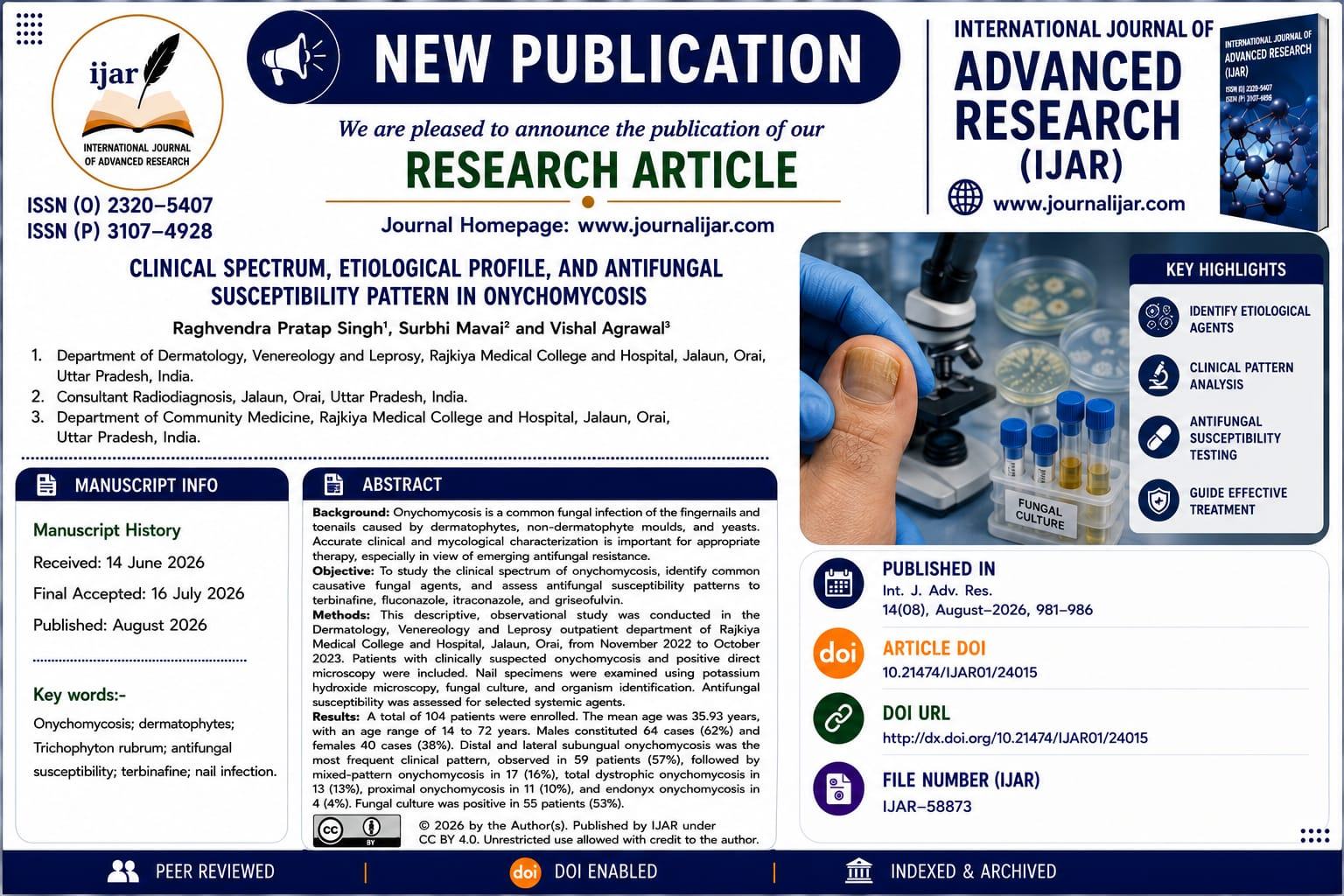
🎉 Proud to contribute to scientific research! Share your publication with your colleagues and professional network.
Article Analytics
Similar Articles
15
143
67
368
16
217
47
307
37
230
 This work is licensed under a Creative Commons Attribution 4.0 International License.