


WHEN EDUCATION TRANSLATES INTO WORK: THE ROLE OF TECHNICAL QUALIFICATIONS
- Research scholar, Central University of Kashmir.
3 Downloads
192 Views

Abstract
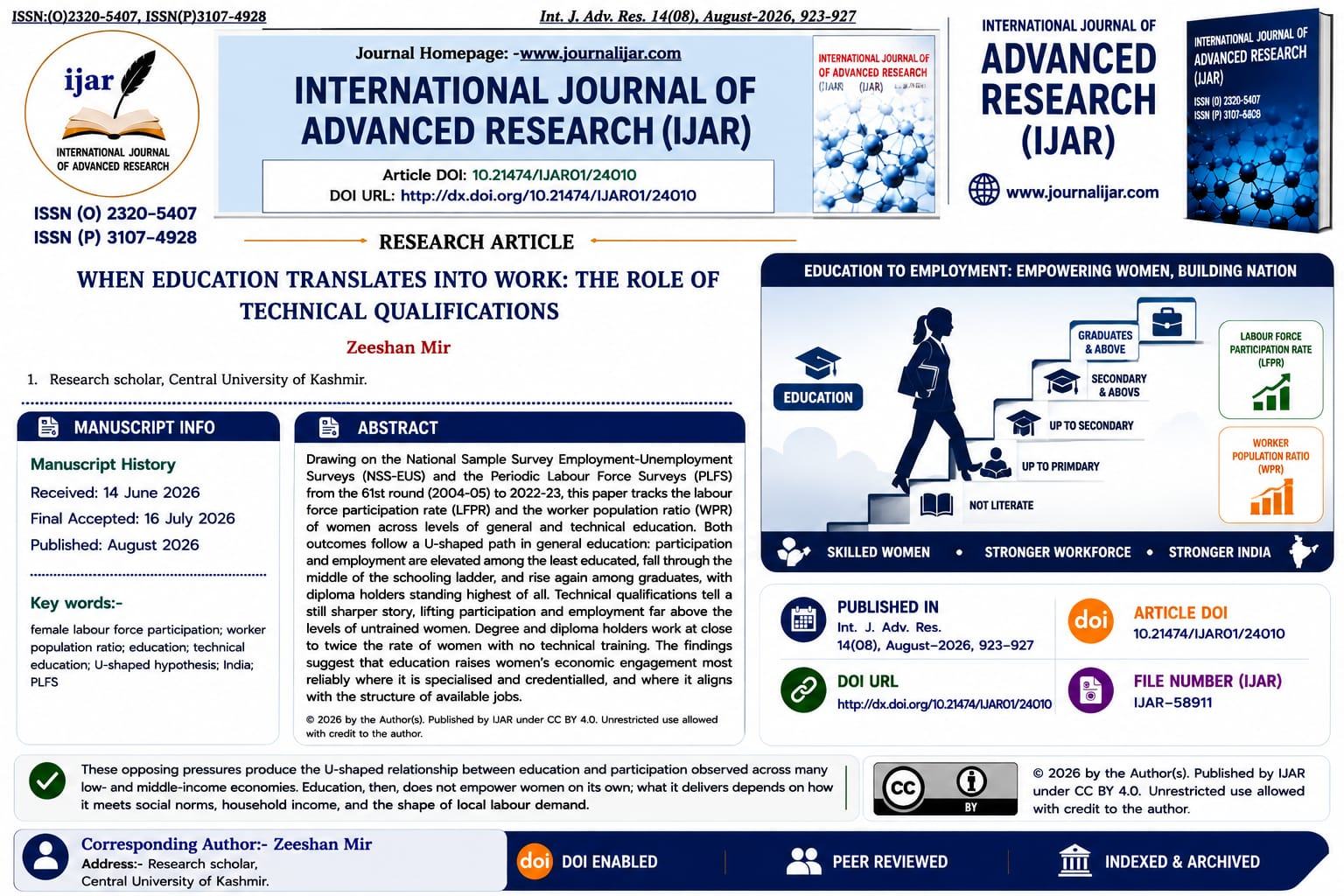
Drawing on the National Sample Survey Employment-Unemployment Surveys (NSS-EUS) and the Periodic Labour Force Surveys (PLFS) from the 61st round (2004-05) to 2022-23, this paper tracks the labour force participation rate (LFPR) and the worker population ratio (WPR) of women across levels of general and technical education. Both outcomes follow a U-shaped path in general education: participation and employment are elevated among the least educated, fall through the middle of the schooling ladder, and rise again among graduates, with diploma holders standing highest of all. Technical qualifications tell a still sharper story, lifting participation and employment far above the levels of untrained women. Degree and diploma holders work at close to twice the rate of women with no technical training. The findings suggest that education raises womens economic engagement most reliably where it is specialised and credentialled, and where it aligns with the structure of available jobs.
Keywords
How to Cite This Article
Zeeshan Mir (2026); WHEN EDUCATION TRANSLATES INTO WORK: THE ROLE OF TECHNICAL QUALIFICATIONS, International Journal of Advanced Research (IJAR), 14 (08), 923-927, ISSN 2320-5407. DOI: https://doi.org/10.21474/IJAR01/24010
Corresponding Author
Publication Achievement
Publication card
🎉 Proud to contribute to scientific research! Share your publication with your colleagues and professional network.
Article Analytics
Similar Articles
1
146
3
130
13
239
8
226
17
333
 This work is licensed under a Creative Commons Attribution 4.0 International License.