


ARTIFICIAL INTELLIGENCE IN ORTHODONTICS: CURRENT APPLICATIONS AND FUTURE DIRECTIONS - A NARRATIVE REVIEW
3 Downloads
265 Views

Abstract
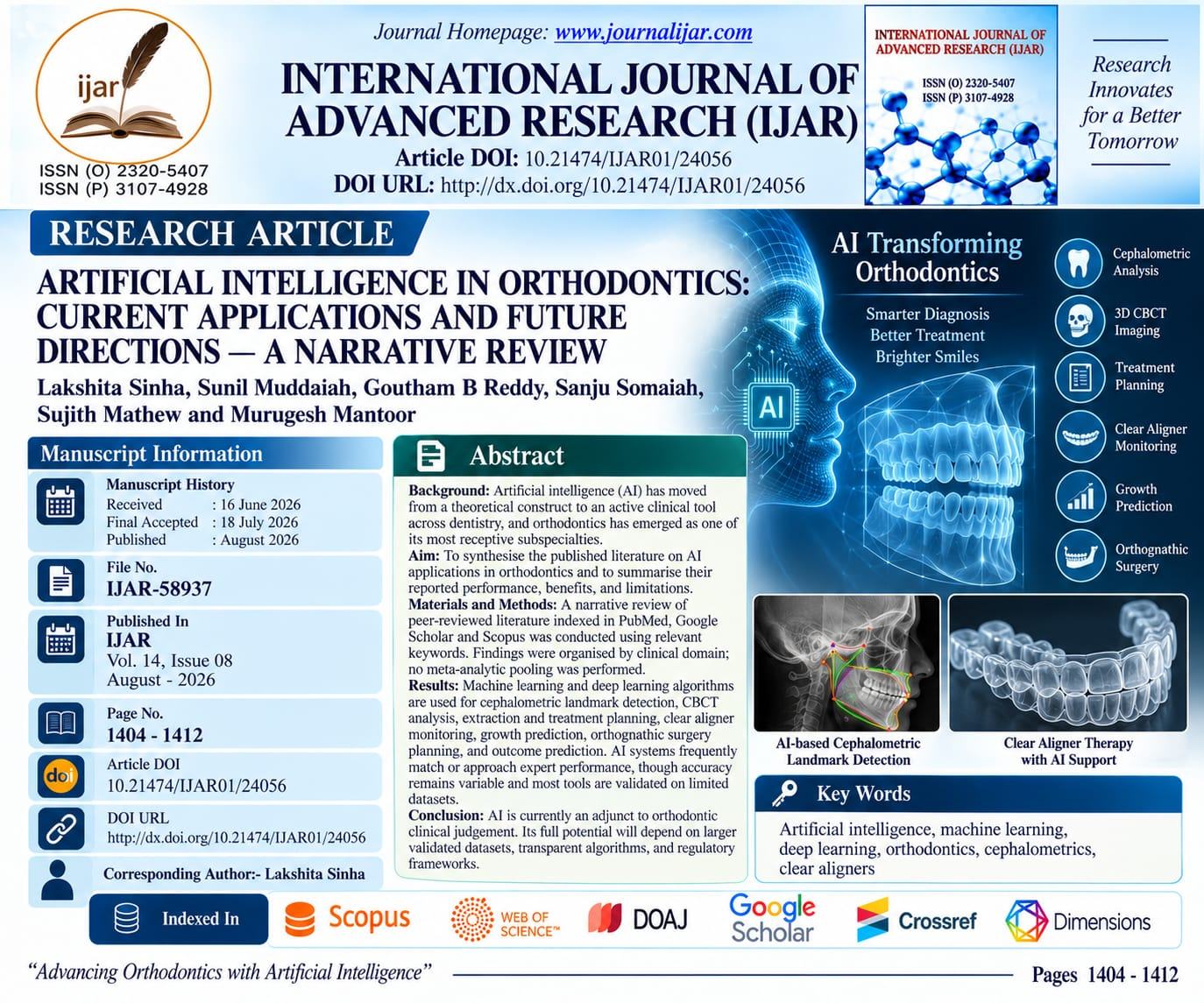
Background: Artificial intelligence (AI) has moved from a theoretical construct in computer science to an active clinical tool across dentistry, and orthodontics has emerged as one of its most receptive subspecialties Aim: To synthesise the published literature on AI applications across the major domains of orthodontic practice and to summarise their reported performance, benefits, and limitations.
Results: Machine learning and deep learning algorithms are now used to trace cephalometric landmarks, analyse cone beam computed tomography (CBCT) volumes, support extraction and treatment planning decisions, monitor clear aligner therapy remotely, predict pubertal growth timing, plan orthognathic surgery, and forecast treatment outcomes in Class II and Class III malocclusion. Across these applications, AI-based systems frequently match or approach the performance of experienced clinicians while reducing time and inter-observer variability, though accuracy remains uneven for anatomically complex or poorly imaged landmarks, and most tools remain validated on limited, single-centre datasets.
Keywords
How to Cite This Article
Lakshita Sinha et, al (2026); ARTIFICIAL INTELLIGENCE IN ORTHODONTICS: CURRENT APPLICATIONS AND FUTURE DIRECTIONS - A NARRATIVE REVIEW, International Journal of Advanced Research (IJAR), 14 (08), 1404-1412, ISSN 2320-5407. DOI: https://doi.org/10.21474/IJAR01/24056
Corresponding Author
Publication Achievement
Publication card
🎉 Proud to contribute to scientific research! Share your publication with your colleagues and professional network.
Article Analytics
Similar Articles
4
194
1
217
1
188
9
284
26
284
 This work is licensed under a Creative Commons Attribution 4.0 International License.