


QUATERNARY VOLCANIC ERUPTION TOBA ASH FALL ITS IMPACTS ON ENVIRONMENT OF LATE PLEISTOCENE HOMININES IN INDIAN SUBCONTINENT WITH SPECIAL REFERENCE TO NARMADA VALLEY. INDIA
- Ex-Director Government of India.
- Summer Volunteer Research Assistant, Contesttoga, High School Berwyn, PA 19087 U.S.A.
3 Downloads
191 Views

Abstract
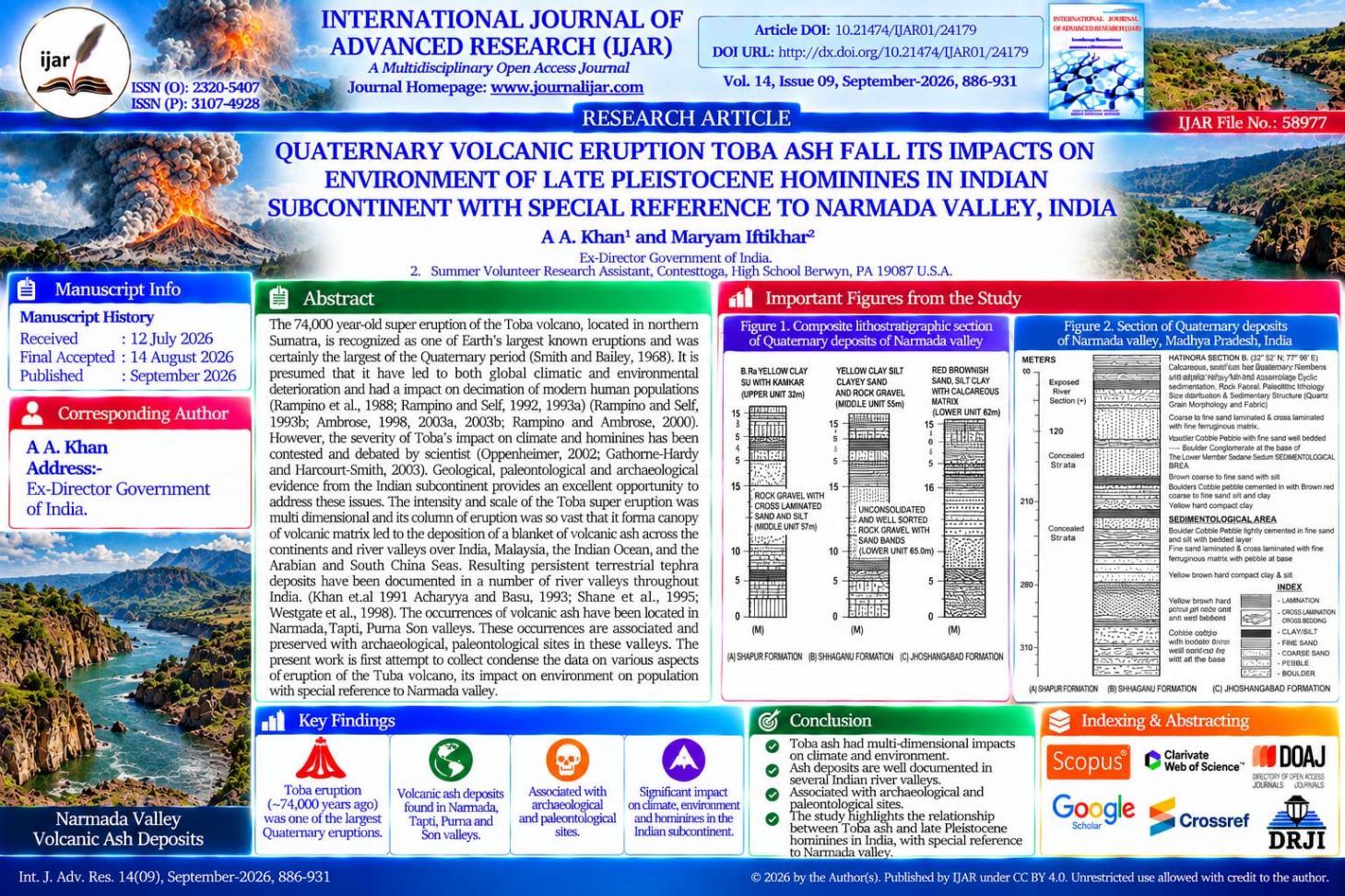
The 74,000 year-old super eruption of the Toba volcano, located in northern Sumatra, is recognized as one of Earths largest known eruptions and was certainly the largest of the Quaternary period (Smith and Bailey, 1968). It is presumed that it have led to both global climatic and environmental deterioration and had a impact on decimation of modern human populations (Rampino et al., 1988; Rampino and Self, 1992, 1993a) (Rampino and Self, 1993b; Ambrose, 1998, 2003a, 2003b; Rampino and Ambrose, 2000). However, the severity of Tobas impact on climate and hominines has been contested and debated by scientist (Oppenheimer, 2002; Gathorne-Hardy and Harcourt-Smith, 2003). Geological, paleontological and archaeological evidence from the Indian subcontinent provides an excellent opportunity to address these issues. The intensity and scale of the Toba super eruption was multi dimensional and its column of eruption was so vast that it forma canopy of volcanic matrix led to the deposition of a blanket of volcanic ash across the continents and river valleys over India, Malaysia, the Indian Ocean, and the Arabian and South China Seas. Resulting persistent terrestrial tephra deposits have been documented in a number of river valleys throughout India. (Khan et.al 1991 Acharyya and Basu, 1993; Shane et al., 1995; Westgate et al., 1998).
How to Cite This Article
A A. Khan (2026); QUATERNARY VOLCANIC ERUPTION TOBA ASH FALL ITS IMPACTS ON ENVIRONMENT OF LATE PLEISTOCENE HOMININES IN INDIAN SUBCONTINENT WITH SPECIAL REFERENCE TO NARMADA VALLEY. INDIA, International Journal of Advanced Research (IJAR), 14 (09), 886-931, ISSN 2320-5407. DOI: https://doi.org/10.21474/IJAR01/24179
Corresponding Author
Publication Achievement
Publication card
🎉 Proud to contribute to scientific research! Share your publication with your colleagues and professional network.
Article Analytics
 This work is licensed under a Creative Commons Attribution 4.0 International License.