


TRADITIONAL SONRU PRODUCTION AS A BIOPROCESS FOR DETOXIFICATION AND NUTRITIONAL ENHANCEMENT OF MUCUNA PRURIENS SEEDS
- Laboratory of Nutrition and Food Sciences, Faculty of Agronomy, University of Parakou, P.O. Box 123 Parakou, Benin.
- Laboratory of Organic Chemistry and Environmental Sciences (LACOSE), Department of Chemistry, University of Kara, P.O. Box 401, Kara, Togo.
- Laboratory of Food Sciences and Technologies, Faculty of Agronomic Sciences, University of Abomey-Calavi, Abomey-Calavi 03 BP 2819, Benin.
- Laboratory of Process and Natural Resources Engineering, University of Lome, Togo.
- Integrated Production Systems Innovation Lab and Sustainable Land Management (InSPIREs-SLM) Faculty of Agronomy (FA), University of Parakou (UP), PO Box 123, Parakou, Benin.
4 Downloads
200 Views

Abstract
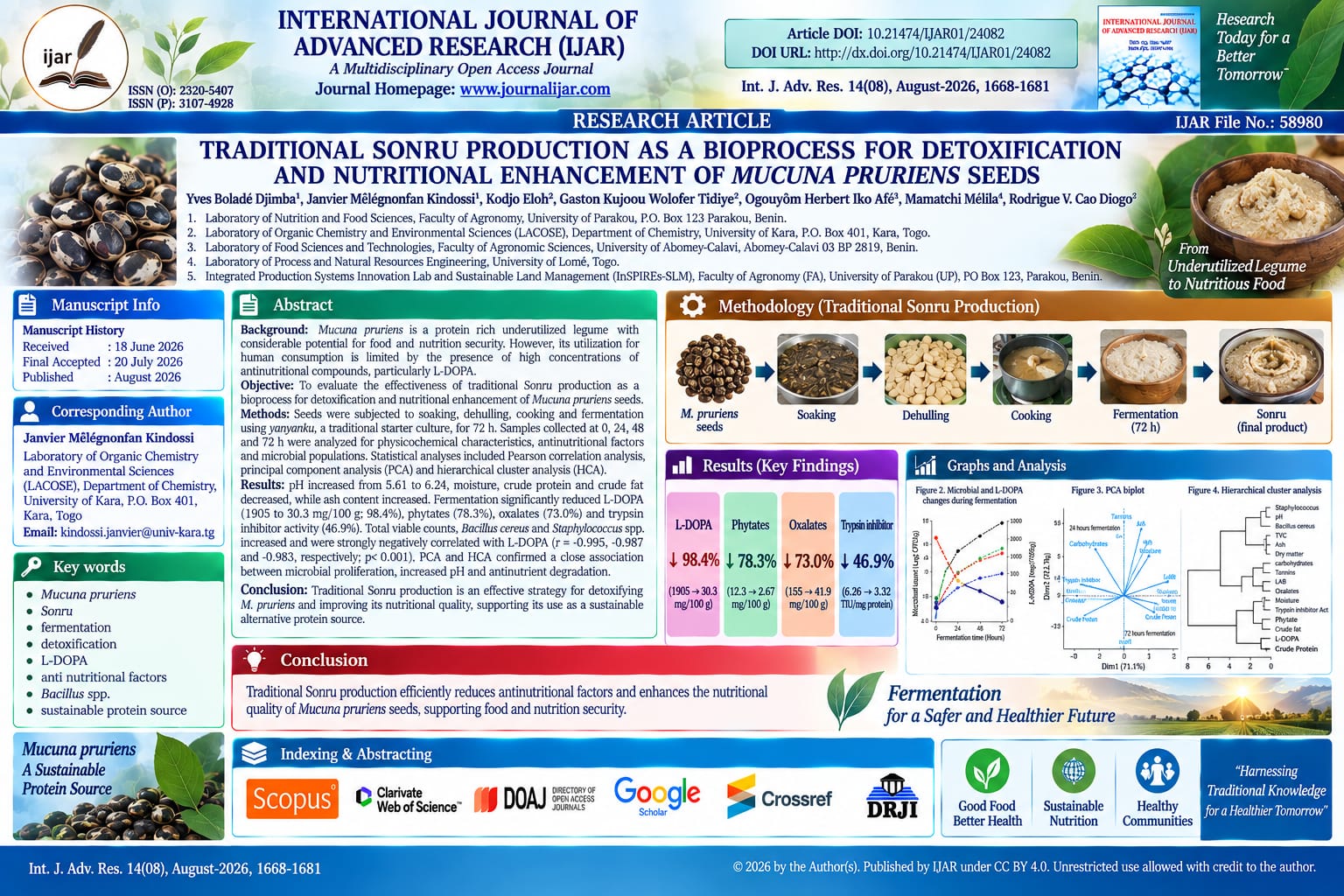
Mucuna pruriens is a protein rich underutilized legume with considerable potential for food and nutrition security. However, its utilization for human consumption is limited by the presence of high concentrations of antinutritional compounds, particularly L-3,4 dihydroxyphenylalanin e (L-DOPA). This study evaluated the effectiveness of traditional Sonru production as a bioprocess for detoxification and nutritional enhancement of Mucuna pruriens seeds. Seeds were subjected to soaking, dehulling, cooking and fermentation using yanyanku, a traditional starter culture, for 72 h under ambient conditions. Samples collected at 0, 24, 48 and 72 h were analyzed for physicochemical characteristics, antinutritional factors and microbial populations. Pearson correlation analysis, principal component analysis (PCA) and hierarchical cluster analysis (HCA) were applied to elucidate relationships among fermentation variables. During fermentation, pH increased significantly from 5.61 to 6.24, whereas moisture, crude protein and crude fat decreased from 75.2 to 63.7%, 38.4 to 33.3 g/100 g, and 4.64 to 2.31 g/100 g, respectively. Ash content increased from 3.87 to 5.78 g/100 g. Fermentation markedly reduced L-DOPA (1905 to 30.3 mg/100 g; 98.4%), phytates (12.3 to 2.67 mg/100 g; 78.3%), oxalates (155 to 41.9 mg/100 g; 73.0%) and trypsin inhibitor activity (6.26 to 3.32 TIU/mg protein; 46.9%), resulting in concentrations below recommended safety thresholds.
Keywords
How to Cite This Article
Yves Bolade Djimba et, al (2026); TRADITIONAL SONRU PRODUCTION AS A BIOPROCESS FOR DETOXIFICATION AND NUTRITIONAL ENHANCEMENT OF MUCUNA PRURIENS SEEDS, International Journal of Advanced Research (IJAR), 14 (08), 1668-1681, ISSN 2320-5407. DOI: https://doi.org/10.21474/IJAR01/24082
Corresponding Author
Publication Achievement
Publication card
🎉 Proud to contribute to scientific research! Share your publication with your colleagues and professional network.
Article Analytics
Similar Articles
87
423
2
147
0
115
14
170
14
127
 This work is licensed under a Creative Commons Attribution 4.0 International License.