


WHEN CREDIT BECOMES A CONSTRAINT: THE LONG-TERM DEBT PARADOX OF FINTECH LENDING AND BORROWER FINANCIAL RESILIENCE IN INDIA
10 Downloads
265 Views

Abstract
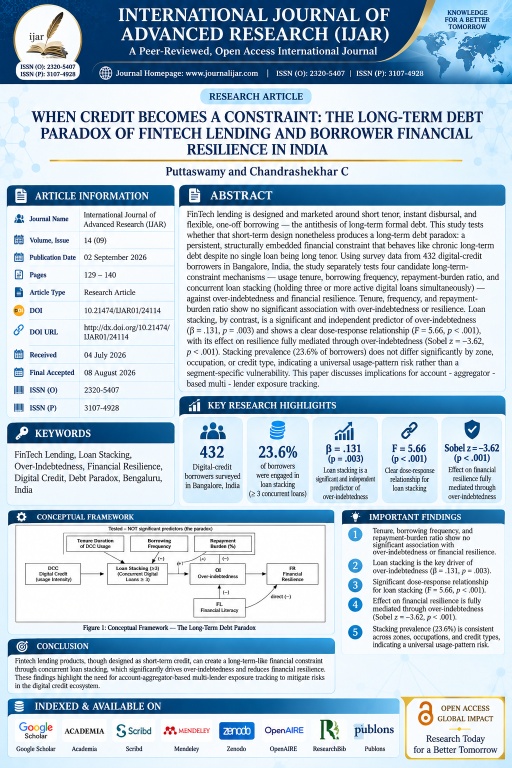
FinTech lending is designed and marketed around short tenor, instant disbursal, and flexible, one-off borrowing - the antithesis of long-term formal debt. This study tests whether that short-term design nonetheless produces a long-term debt paradox: a persistent, structurally embedded financial constraint that behaves like chronic long-term debt despite no single loan being long tenor. Using survey data from 432 digital-credit borrowers in Bangalore, India, the study separately tests four candidate long-term-constraint mechanisms-usage tenure, borrowing frequency, repayment-burden ratio, and concurrent loan stacking (holding three or more active digital loans simultaneously) -against over-indebtedness and financial resilience. Tenure, frequency, and repayment-burden ratio show no significant association with over-indebtedness or resilience.
Keywords
How to Cite This Article
Puttaswamy (2026); WHEN CREDIT BECOMES A CONSTRAINT: THE LONG-TERM DEBT PARADOX OF FINTECH LENDING AND BORROWER FINANCIAL RESILIENCE IN INDIA, International Journal of Advanced Research (IJAR), 14 (09), 129-140, ISSN 2320-5407. DOI: https://doi.org/10.21474/IJAR01/24114
Corresponding Author
Publication Achievement
Publication card
🎉 Proud to contribute to scientific research! Share your publication with your colleagues and professional network.
Article Analytics
Similar Articles
0
16
4
199
5
197
17
327
5
217
 This work is licensed under a Creative Commons Attribution 4.0 International License.