


DIGITAL TRAUMA IN THE AGE OF ARTIFICIAL INTELLIGENCE
- Research Scholar of English St. Joseph University Tamil Nadu.
- Research Supervisor St. Joseph University Tamil Nadu .
6 Downloads
232 Views

Abstract
The rapid expansion of artificial intelligence has transformed everyday human interactions, communication, and decision-making processes, this is simultaneously giving rise to new forms of digital and psychological trauma. Trauma has been identified as not merely a personal state, but a social state as mentioned by Erikson, K. (1976). This paper examines how AI-driven technologies such as surveillance systems, social media algorithms, and algorithmic profiling contribute to experiences of anxiety, emotional distress, and digital vulnerability. Zuboff, S. (2019) have clearly stated that technological systems do not merely process data; they actively shape human vulnerability and lived experience. This study relies of trauma theory and critical technology studies, to analyse the ways in which constant monitoring, feedback and data extraction intensify power imbalances. The paper explores the research in the field and proposes the need for trauma-informed approaches to the development and implementation of AI technologies, emphasizing empathy, transparency, user autonomy, and ethical accountability.
Keywords
How to Cite This Article
Dr Mary Binu T D (2026); DIGITAL TRAUMA IN THE AGE OF ARTIFICIAL INTELLIGENCE, International Journal of Advanced Research (IJAR), 14 (09), 188-193, ISSN 2320-5407. DOI: https://doi.org/10.21474/IJAR01/24119
Corresponding Author
Publication Achievement
Publication card
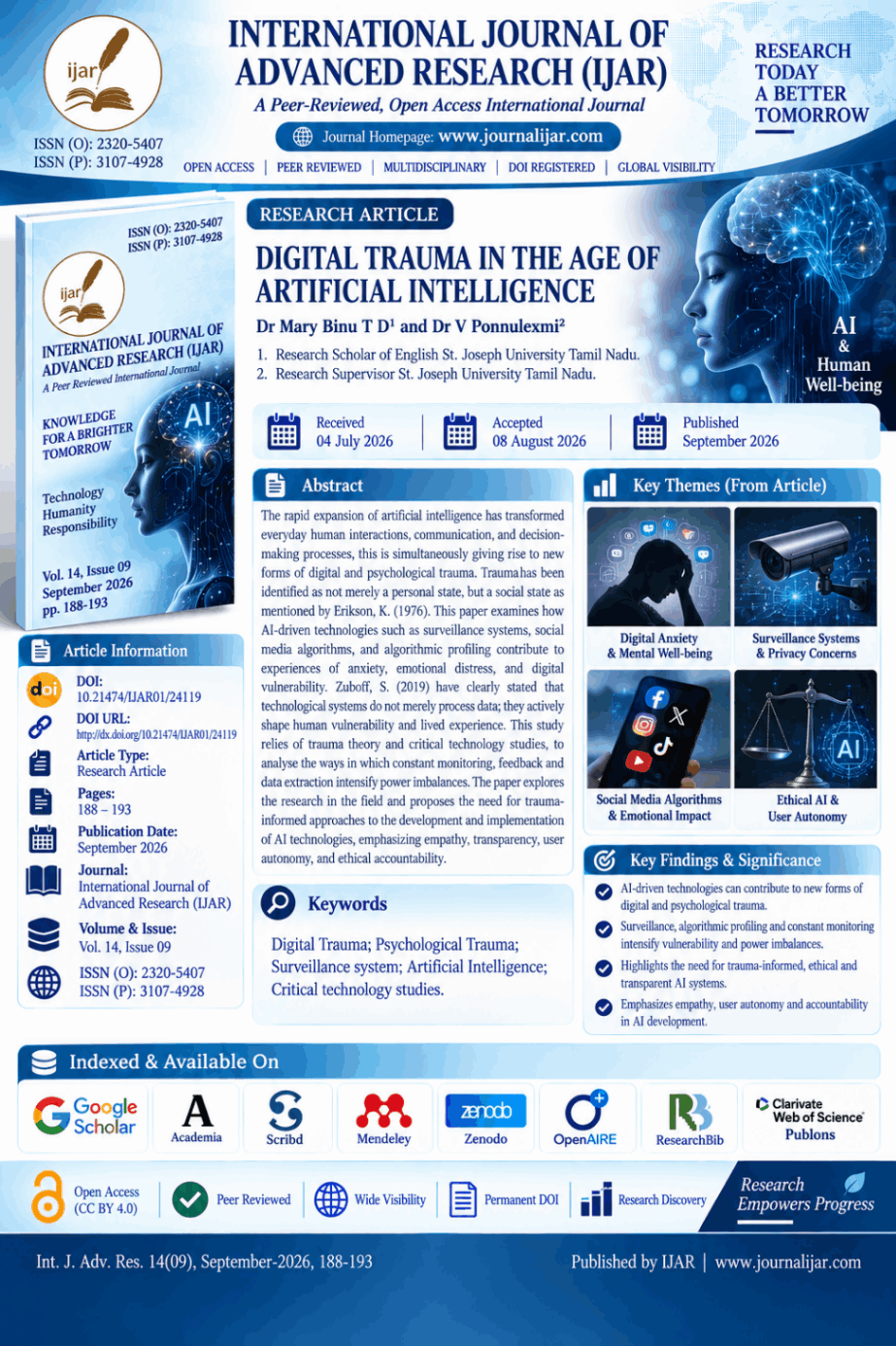
🎉 Proud to contribute to scientific research! Share your publication with your colleagues and professional network.
Article Analytics
Similar Articles
0
29
0
22
0
29
3
33
3
108
 This work is licensed under a Creative Commons Attribution 4.0 International License.