


NEONATAL HYPOCALCEMIA AND THE MATERNAL-NEONATAL VITAMIN D AXIS: A TERTIARY NICU CROSS-SECTIONAL STUDY
9 Downloads
170 Views

Abstract
Neonatal hypocalcemia, a frequently encountered metabolic disorder in the Neonatal Intensive Care Unit (NICU), can pose serious health risks to newborns. It is typically defined by reduced serum calcium levels, with threshold values varying based on gestational age and birth weight. In term infants and preterm neonates weighing more than 1500 g, hypocalcemia is considered when total serum calcium falls below 8 mg/dL (2 mmol/L) or ionized calcium below 4.4 mg/dL (1.1 mmol/L). In very low birth weight infants (1500 g), lower cutoff values are used [1]. Based on time of onset, neonatal hypocalcemia is broadly categorized into Early-onset hypocalcemia (EOH) and Late-onset hypocalcemia (LOH). Early-onset hypocalcemia usually develops within the first 72 hours of life and is associated with a physiological decline in calcium levels after birth, along with a delayed parathyroid hormone response. In contrast, late-onset hypocalcemia typically presents after the initial 3 days, often toward the end of the first postnatal week, and is more likely to be symptomatic.[2]. The clinical presentation can vary widely. Some neonates may exhibit mild features such as irritability, tremors, or increased neuromuscular excitability, while others may develop more severe complications including seizures, apnea, or cardiac dysfunction [3,4]. Hence, early detection and prompt management are indispensable, as untreated neonatal hypocalcemia can adversely affect neurodevelopment and skeletal mineralization.
How to Cite This Article
Dhakchennya Sekar et,al (2026); NEONATAL HYPOCALCEMIA AND THE MATERNAL-NEONATAL VITAMIN D AXIS: A TERTIARY NICU CROSS-SECTIONAL STUDY, International Journal of Advanced Research (IJAR), 14 (09), 382-388, ISSN 2320-5407. DOI: https://doi.org/10.21474/IJAR01/24133
Corresponding Author
Publication Achievement
Publication card
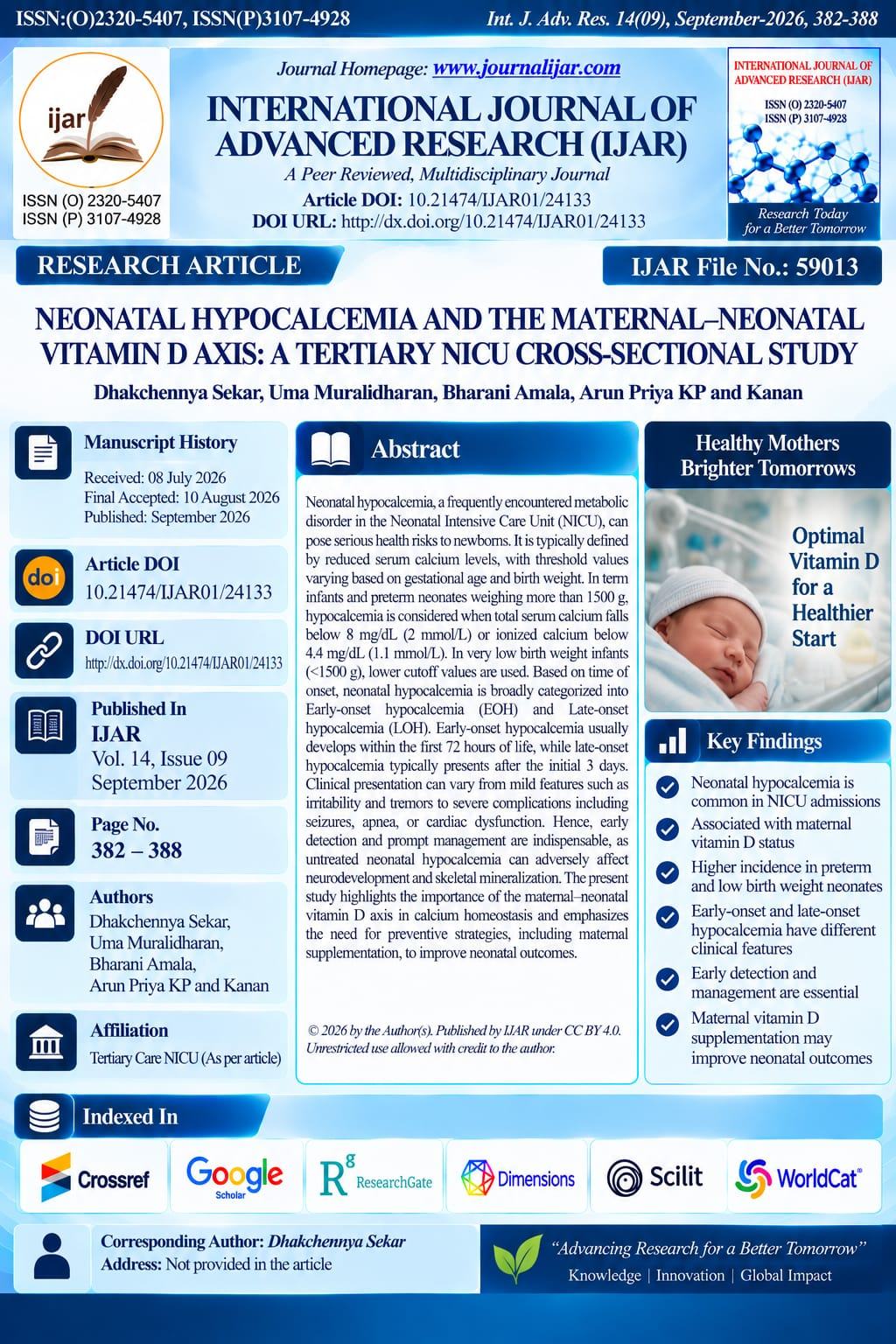
🎉 Proud to contribute to scientific research! Share your publication with your colleagues and professional network.
Article Analytics
 This work is licensed under a Creative Commons Attribution 4.0 International License.