


MICROCALORIMETRIC ASSESSMENT OF THE BIODEGRADATION KINETICS OF DIETHYL PHTHALATE AND DIBUTYL PHTHALATE BY PURE MICROBIAL CULTURES
- School of Postgraduate Studies, Magburaka Campus, Ernest Bai Koroma University of Science and Technology, Sierra Leone.
3 Downloads
196 Views

Abstract
Phthalic acid esters (PAEs) are ubiquitous environmental contaminants with documented endocrine-disrupting properties, yet comprehensive understanding of their biodegradation kinetics remains incomplete. This study employed isothermal microcalorimetry to investigate the biodegradation of diethyl phthalate (DEP) and dibutyl phthalate (DBP) by three pure microbial cultures: Escherichia coli, Staphylococcus aureus, and Aspergillus niger.Microcalorimetric thermograms provided real-time metabolic fingerprints, enabling quantification of growth rate constants (k), heat output (Pmax), and inhibition ratios (I). Both PAEs exhibited concentration-dependent inhibition, with DBP demonstrating greater toxicity.
Keywords
How to Cite This Article
Alhaji Brima Gogra (2026); MICROCALORIMETRIC ASSESSMENT OF THE BIODEGRADATION KINETICS OF DIETHYL PHTHALATE AND DIBUTYL PHTHALATE BY PURE MICROBIAL CULTURES, International Journal of Advanced Research (IJAR), 14 (09), 1167-1175, ISSN 2320-5407. DOI: https://doi.org/10.21474/IJAR01/24202
Corresponding Author
Publication Achievement
Publication card
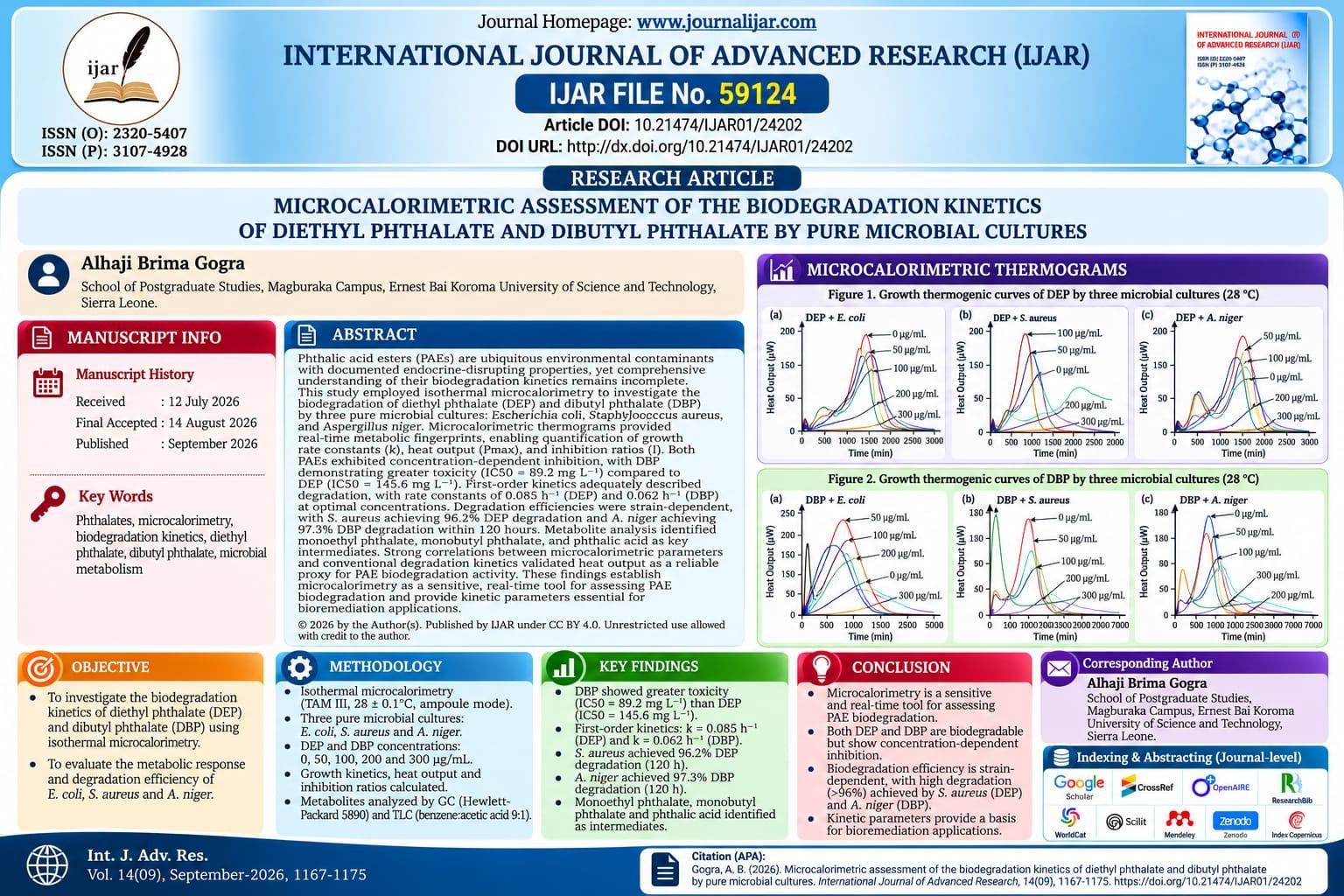
🎉 Proud to contribute to scientific research! Share your publication with your colleagues and professional network.
Article Analytics
Similar Articles
 This work is licensed under a Creative Commons Attribution 4.0 International License.