


AI, TECHNOLOGY, AND THE FUTURE OF LANGUAGE STUDIES: OPPORTUNITIES, CHALLENGES, AND TRANSFORMATIONS
2 Downloads
216 Views

Abstract
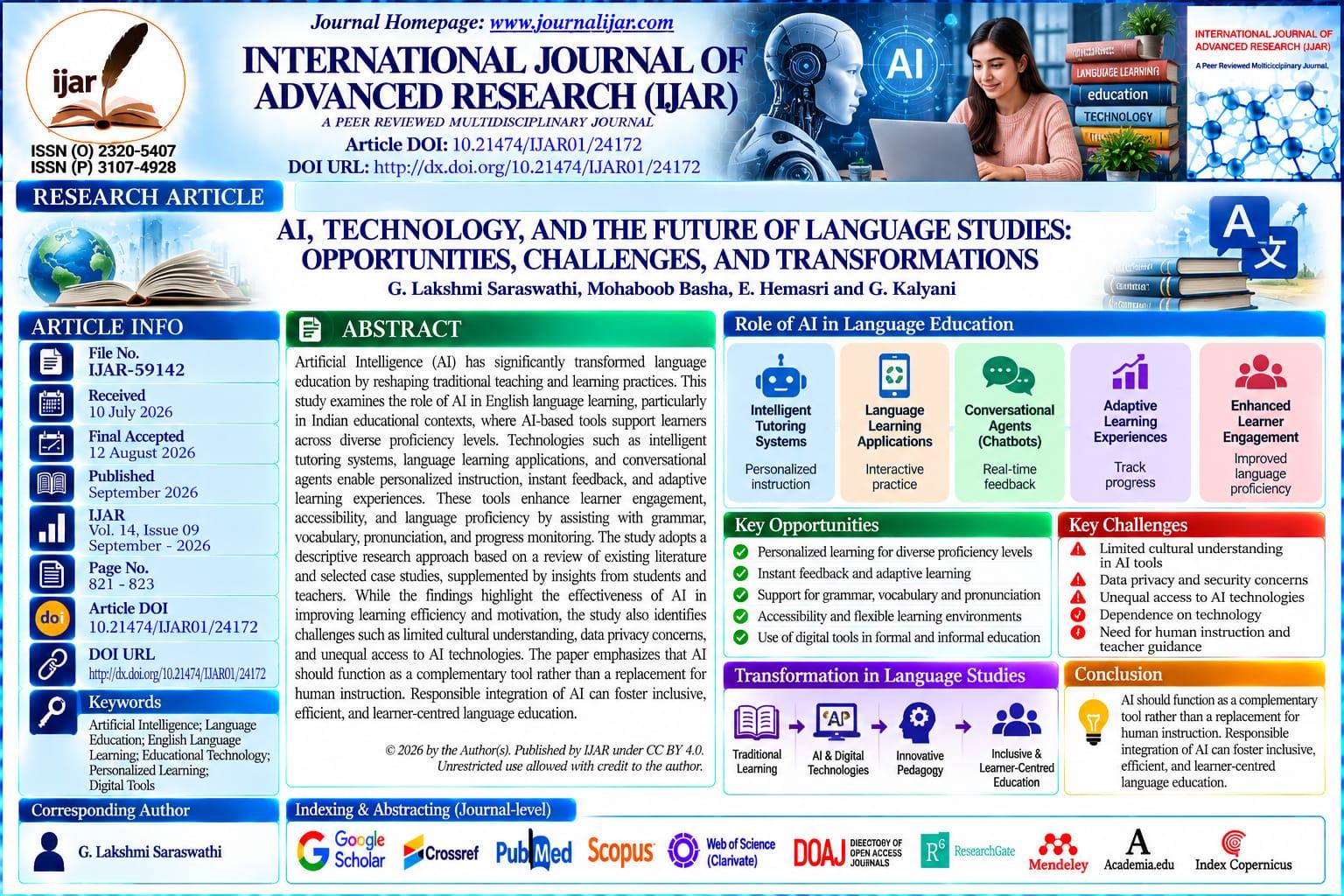
Artificial Intelligence (AI) has significantly transformed language education by reshaping traditional teaching and learning practices. This study examines the role of AI in English language learning, particularly in Indian educational contexts, where AI-based tools support learners across diverse proficiency levels. Technologies such as intelligent tutoring systems, language learning applications, and conversational agents enable personalized instruction, instant feedback, and adaptive learning experiences. These tools enhance learner engagement, accessibility, and language proficiency by assisting with grammar, vocabulary, pronunciation, and progress monitoring. The study adopts a descriptive research approach based on a review of existing literature and selected case studies, supplemented by insights from students and teachers. While the findings highlight the effectiveness of AI in improving learning efficiency and motivation, the study also identifies challenges such as limited cultural understanding, data privacy concerns, and unequal access to AI technologies. The paper emphasizes that AI should function as a complementary tool rather than a replacement for human instruction. Responsible integration of AI can foster inclusive, efficient, and learner-centred language education.
Keywords
How to Cite This Article
G. Lakshmi Saraswathi et,al (2026); AI, TECHNOLOGY, AND THE FUTURE OF LANGUAGE STUDIES: OPPORTUNITIES, CHALLENGES, AND TRANSFORMATIONS, International Journal of Advanced Research (IJAR), 14 (09), 821-823, ISSN 2320-5407. DOI: https://doi.org/10.21474/IJAR01/24172
Corresponding Author
Publication Achievement
Publication card
🎉 Proud to contribute to scientific research! Share your publication with your colleagues and professional network.
Article Analytics
Similar Articles
6
325
13
249
16
239
170
1232
139
619
 This work is licensed under a Creative Commons Attribution 4.0 International License.