


UNIVERSAL DESIGN FOR LEARNING IN INCLUSIVE SCIENCE EDUCATION FOR STUDENTS WITH DISABILITIES
- Senior Faculty, Mastermind English Medium School, Dhaka, Bangladesh.
- Professor, Institute of Education and Research, University of Dhaka, Bangladesh.
- Assistant Professor, Department of Disability Studies, Rabindra Bharati University, Kolkata.
- Assistant Professor, Department of Education, Regional Institute of Education, NCERT, Mysuru.
3 Downloads
217 Views

Abstract
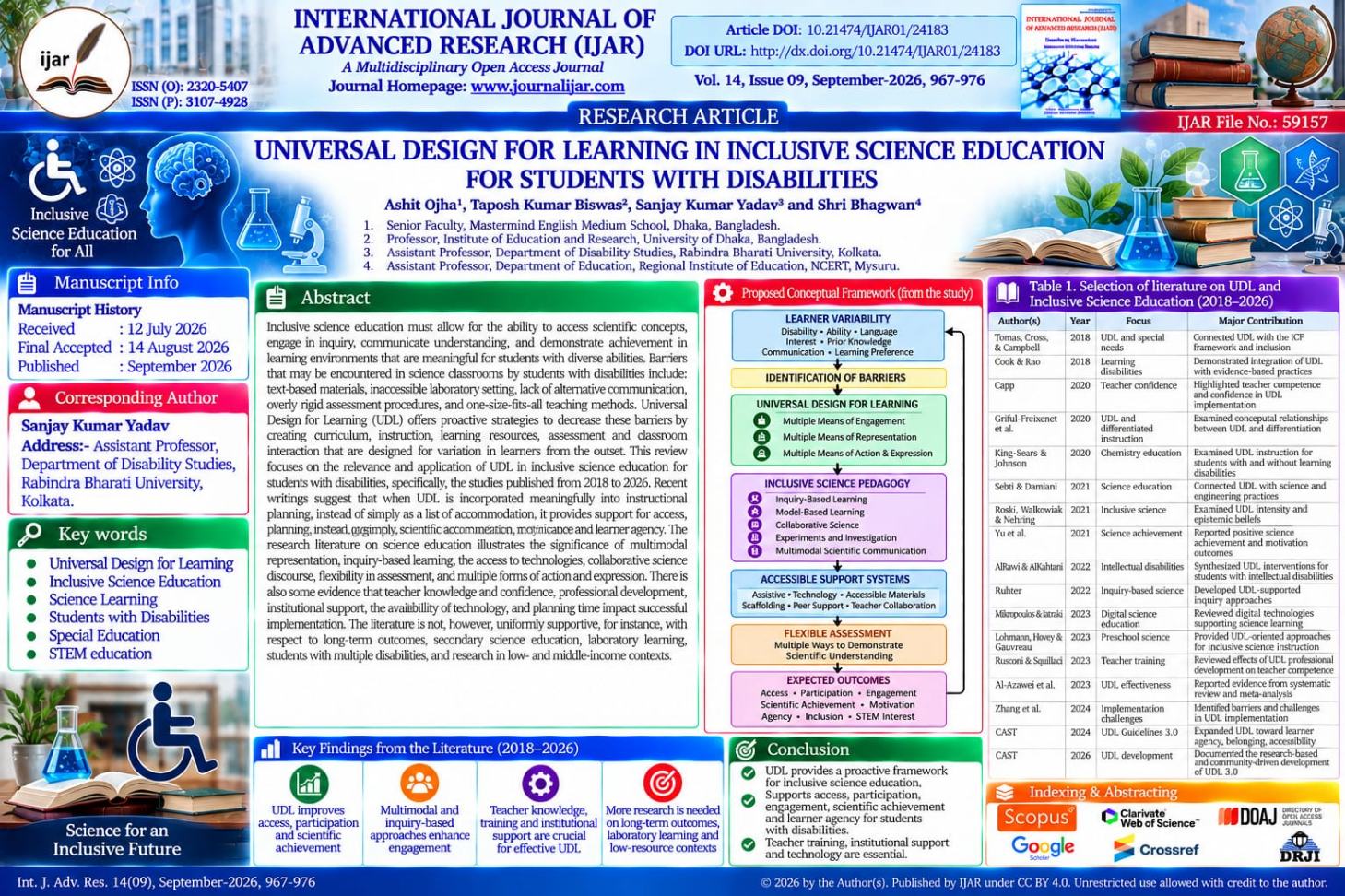
Inclusive science education must allow for the ability to access scientific concepts, engage in inquiry, communicate understanding, and demonstrate achievement in learning environments that are meaningful for students with diverse abilities. Barriers that may be encountered in science classrooms by students with disabilities include: text-based materials, inaccessible laboratory setting, lack of alternative communication, overly rigid assessment procedures, and one-size-fits-all teaching methods. Universal Design for Learning (UDL) offers proactive strategies to decrease these barriers by creating curriculum, instruction, learning resources, assessment and classroom interaction that are designed for variation in learners from the outset. This review focuses on the relevance and application of UDL in inclusive science education for students with disabilities, specifically, the studies published from 2018 to 2026. Recent writings suggest that when UDL is incorporated meaningfully into instructional planning, instead of simply as a list of accommodation, it provides support for access, participation, engagement, scientific achievement, motivation and learner agency. The research literature on science education illustrates the significance of multimodal representation, inquiry-based learning, the access to technologies, collaborative science discourse, flexibility in assessment, and multiple forms of action and expression. There is also some evidence that teacher knowledge and confidence, professional development, institutional support, the availability of technology, and planning time impact successful implementation. The literature is not, however, uniformly supportive, for instance, with respect to long-term outcomes, secondary science education, laboratory learning, students with multiple disabilities, and research in low- and middle-income contexts.
Keywords
How to Cite This Article
Ashit Ojha et,al (2026); UNIVERSAL DESIGN FOR LEARNING IN INCLUSIVE SCIENCE EDUCATION FOR STUDENTS WITH DISABILITIES, International Journal of Advanced Research (IJAR), 14 (09), 967-976, ISSN 2320-5407. DOI: https://doi.org/10.21474/IJAR01/24183
Corresponding Author
Publication Achievement
Publication card
🎉 Proud to contribute to scientific research! Share your publication with your colleagues and professional network.
Article Analytics
Similar Articles
21
195
9
191
12
248
12
193
9
199
 This work is licensed under a Creative Commons Attribution 4.0 International License.