


LATE DIAGNOSIS OF A POST-INFARCTION VENTRICULAR SEPTAL DEFECT: AN UNUSUAL PRESENTATION
- Department of Cardiology, Genevieve Anthonioz De Gaulle Hospital Center, Saint-Dizier, France.
1 Downloads
150 Views

Abstract
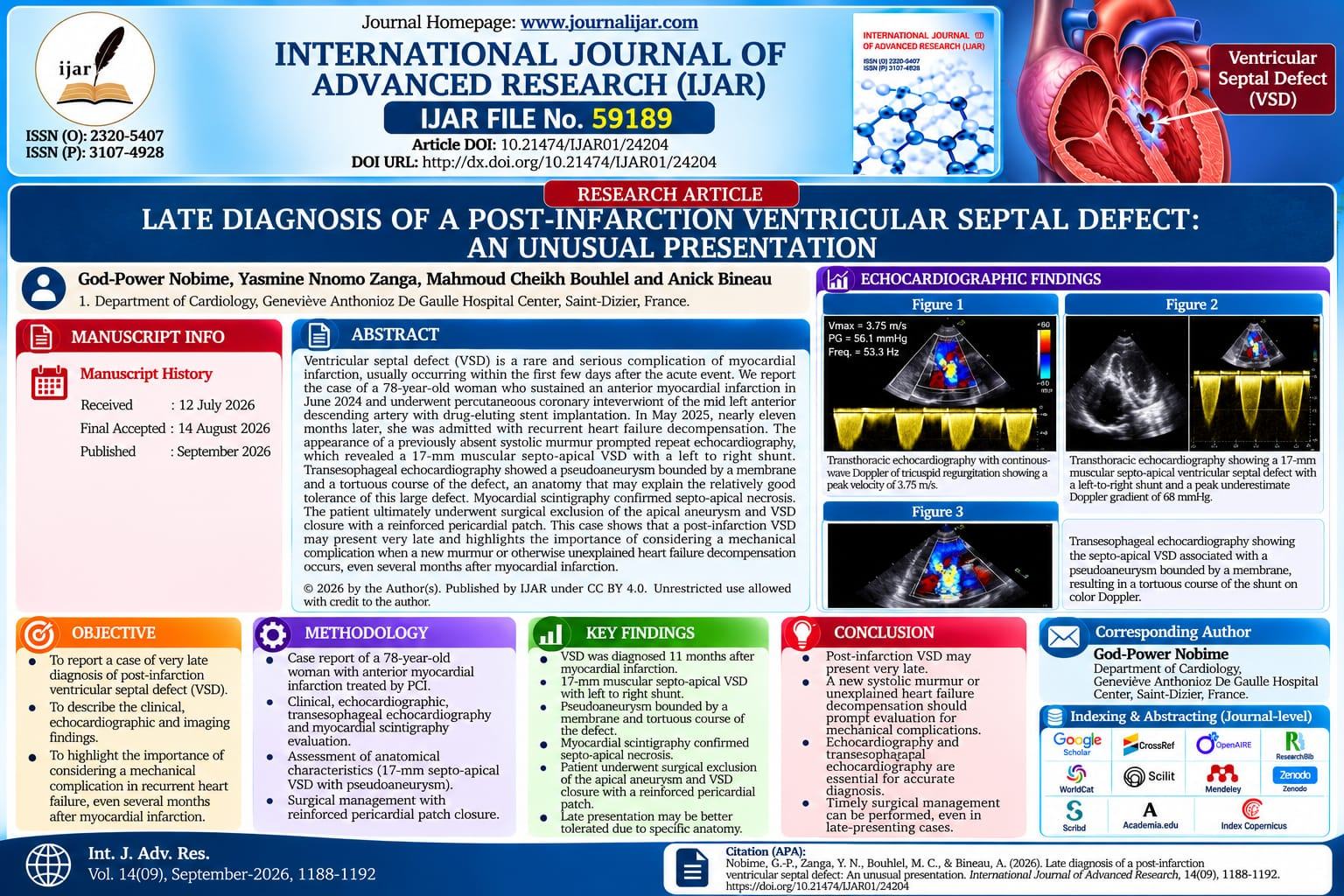
Ventricular septal defect (VSD) is a rare and serious complication of myocardial infarction, usually occurring within the first few days after the acute event. We report the case of a 78-year-old woman who sustained an anterior myocardial infarction in June 2024 and underwent percutaneous coronary intervention of the mid left anterior descending artery with drug-eluting stent implantation. In May 2025, nearly eleven months later, she was admitted with recurrent heart failure decompensation. The appearance of a previously absent systolic murmur prompted repeat echocardiography, which revealed a 17-mm muscular septo-apical VSD with a left to right shunt. Transesophageal echocardiography showed a pseudoaneurysm bounded by a membrane and a tortuous course of the defect, an anatomy that may explain the relatively good tolerance of this large defect. Myocardial scintigraphy confirmed septo-apical necrosis. The patient ultimately underwent surgical exclusion of the apical aneurysm and VSD closure with a reinforced pericardial patch. This case shows that a post-infarction VSD may present very late and highlights the importance of considering a mechanical complication when a new murmur or otherwise unexplained heart failure decompensation occurs, even several months after myocardial infarction.
How to Cite This Article
God-Power Nobime et,al (2026); LATE DIAGNOSIS OF A POST-INFARCTION VENTRICULAR SEPTAL DEFECT: AN UNUSUAL PRESENTATION, International Journal of Advanced Research (IJAR), 14 (09), 1188-1192, ISSN 2320-5407. DOI: https://doi.org/10.21474/IJAR01/24204
Corresponding Author
Publication Achievement
Publication card
🎉 Proud to contribute to scientific research! Share your publication with your colleagues and professional network.
Article Analytics
 This work is licensed under a Creative Commons Attribution 4.0 International License.