


DESIGNING THE AI WEB: ARCHITECTURAL PRINCIPLES FOR INTEROPERABLE ARTIFICIAL INTELLIGENCE SYSTEMS
- Delhi Public School, R. K. Puram, New Delhi.
2 Downloads
182 Views

Abstract
With the field of artificial intelligence undergoing constant evolution, AI systems are rapidly shifting from single models to complex networks that involve countless specialised agents. This transition is supported by several studies that have established multi-agent systems to offer advanced capabilities when compared to single LLM-powered agents. While it is aimed for these to work together by interacting with one another, the absence of a standard structure and mode of communication proves to be a challenge.This paper introduces and elaborates on the idea of an AI Web, a unified network of interoperable artificial intelligence agents capable of collaborating seamlessly across numerous diverse frameworks and applications. We draw inspiration from the internet, where machines use certain protocols for communication. Building upon previous studies, we propose a nine-layer structure embedded with Model Context Protocol (MCP) and Agent-to-Agent (A2A) protocols to allow effective communication between agents. The model was conceptually evaluated through application scenarios in enterprise and business domains.
Keywords
How to Cite This Article
Ose Gupta (2026); DESIGNING THE AI WEB: ARCHITECTURAL PRINCIPLES FOR INTEROPERABLE ARTIFICIAL INTELLIGENCE SYSTEMS, International Journal of Advanced Research (IJAR), 14 (09), 1193-1206, ISSN 2320-5407. DOI: https://doi.org/10.21474/IJAR01/24205
Corresponding Author
Publication Achievement
Publication card
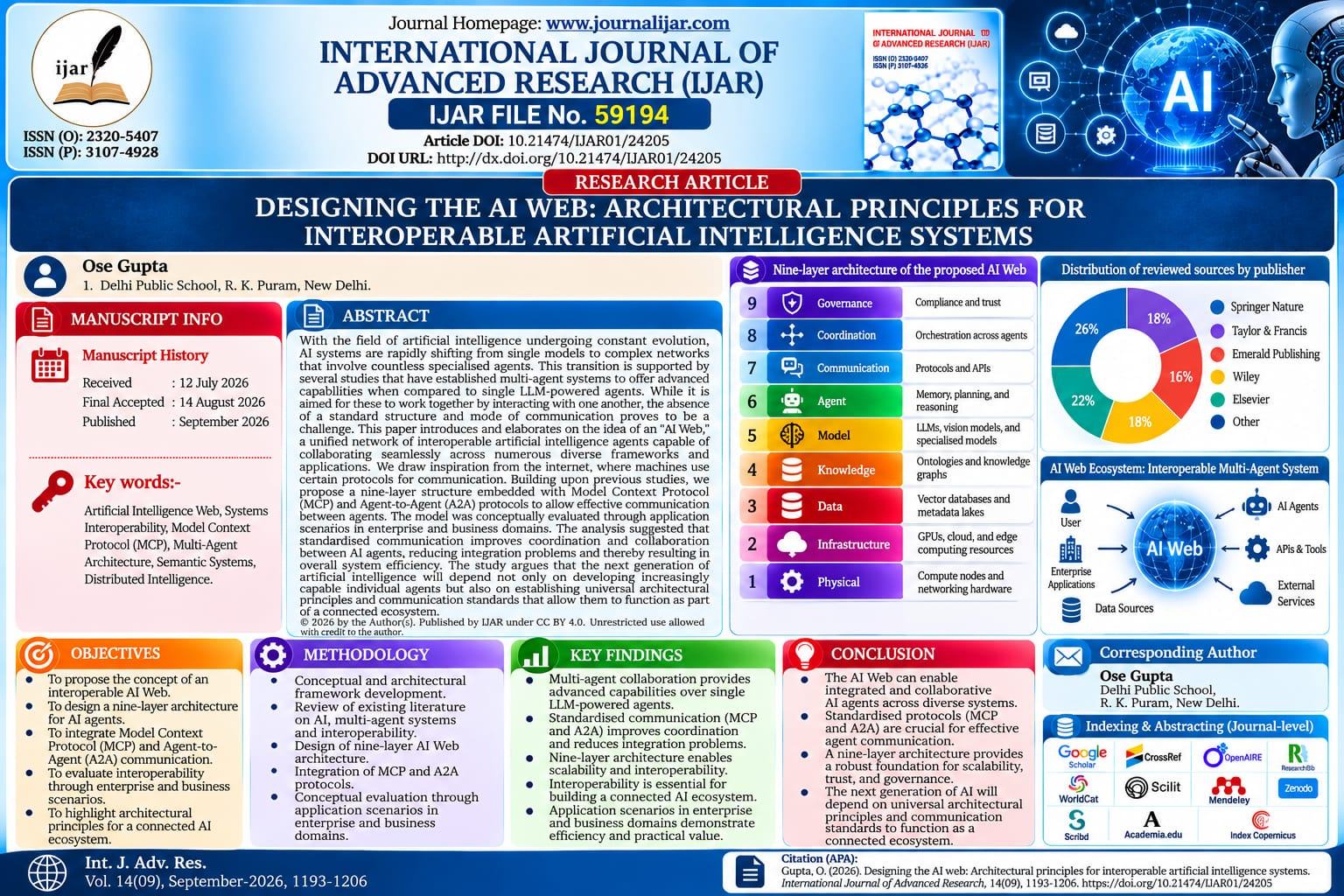
🎉 Proud to contribute to scientific research! Share your publication with your colleagues and professional network.
Article Analytics
 This work is licensed under a Creative Commons Attribution 4.0 International License.