


AI/ML-DRIVEN PREDICTIVE SERVICE MANAGEMENT FOR TELECOM AND ICT INFRASTRUCTURE: A VISION 2030 FRAMEWORK FOR OPERATIONAL RESILIENCE
3 Downloads
194 Views

Abstract
The telecom and information and communication technology (ICT) infrastructure sector is shifting from a fault-management approach that focuses on components to one that is service-oriented and involves predicting potential degradation before it leads to an outage or a breach of service levels. This report brings together research carried out between 2020 and 2025 on the use of machine learning for traffic forecasting, anomaly and fault prediction, network slicing, digital twins, federated learning, explainability, and zero-touch orchestration. The objective is to examine how these capabilities can be combined into a predictive service-management architecture that meets the operational-resilience goals linked to Saudi Arabia's Vision 2030 digital transformation initiative. It has been found that the greatest operational benefit does not come from the individual accuracy of models, but from connecting the forecasts to controlled, closed-loop actions across the radio, transport, cloud, edge, and service layers. Deep temporal models enhance the ability to anticipate demand; anomaly detection systems and fault-prediction systems provide earlier opportunities for intervention; reinforcement learning aids in the adaptive allocation of resources; and digital twins allow for safer assessment of potential actions. Nevertheless, implementation is still limited by problems such as data drift, heterogeneous telemetry, the scarcity of failure labels, cross-domain causality, inference latency, energy consumption, explainability, and questions of organizational accountability. A five-stage framework is suggested: observe, predict, diagnose, decide, and assure.
How to Cite This Article
Wamiq Rafi Syed (2026); AI/ML-DRIVEN PREDICTIVE SERVICE MANAGEMENT FOR TELECOM AND ICT INFRASTRUCTURE: A VISION 2030 FRAMEWORK FOR OPERATIONAL RESILIENCE, International Journal of Advanced Research (IJAR), 14 (09), 1234-1246, ISSN 2320-5407. DOI: https://doi.org/10.21474/IJAR01/24208
Corresponding Author
Publication Achievement
Publication card
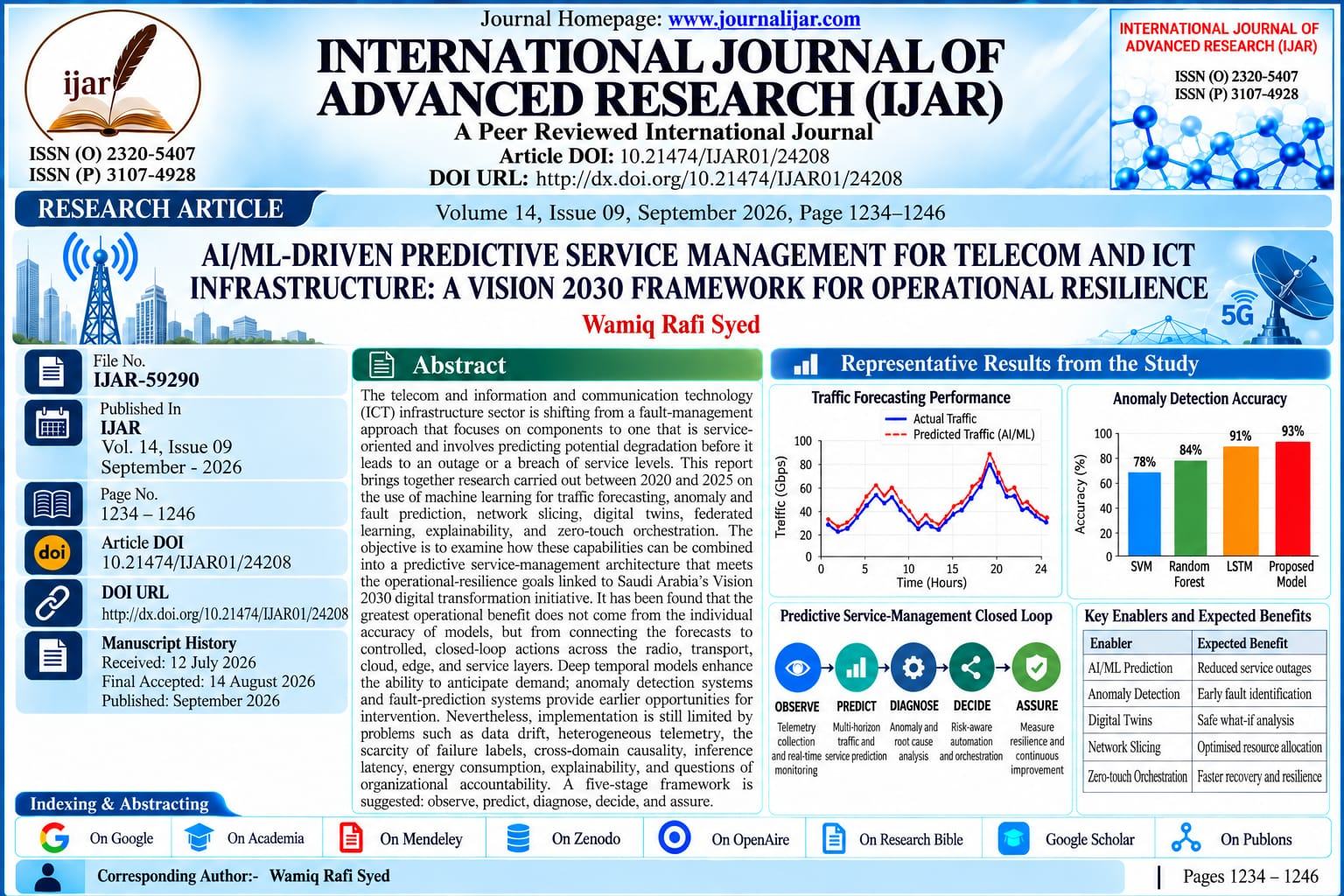
🎉 Proud to contribute to scientific research! Share your publication with your colleagues and professional network.
Article Analytics
 This work is licensed under a Creative Commons Attribution 4.0 International License.