


LOCALIZATION OF INDUSTRIAL LUBRICANTS AND PETROLEUM PRODUCT SUPPLY CHAINS IN SAUDI ARABIAS OIL AND GAS SECTOR UNDER VISION 2030
1060 Downloads
8144 Views

Abstract
The Saudi initiative to localise its industry is now moving the procurement of oil and gas away from simple import substitution and towards the development of domestic capabilities. Industrial lubricants and other petroleum products serve as a good example since they involve regular demand alongside complex formulations, depend on imported additives, have to meet equipment approval requirements, and also have potential in the area of the circular economy. This study draws on peer-reviewed evidence published between 2020 and 2025 to look at where localisation can generate defensible value throughout the supply chain for lubricants and petroleum products and to identify the capabilities needed to ensure reliability, quality, and cost control. A structured integrative review of thirty studies verified by the DOI was carried out and the studies were coded according to feasibility of localisation, supplier capability, resilience, digitalisation, sustainability, and governance. The findings show that localisation should advance at an uneven rate along the value chain. Activities such as blending, packaging, laboratory testing, warehousing, providing field technical services, collecting used oil, and certain re-refining operations present relatively short-term opportunities, while advanced additive chemistry and special formulations need a much longer period for building up capabilities.
How to Cite This Article
Mohammad Imran Khan (2026); LOCALIZATION OF INDUSTRIAL LUBRICANTS AND PETROLEUM PRODUCT SUPPLY CHAINS IN SAUDI ARABIAS OIL AND GAS SECTOR UNDER VISION 2030, International Journal of Advanced Research (IJAR), 14 (09), 1706-1718, ISSN 2320-5407. DOI: https://doi.org/10.21474/IJAR01/24256
Corresponding Author
Publication Achievement
Publication card
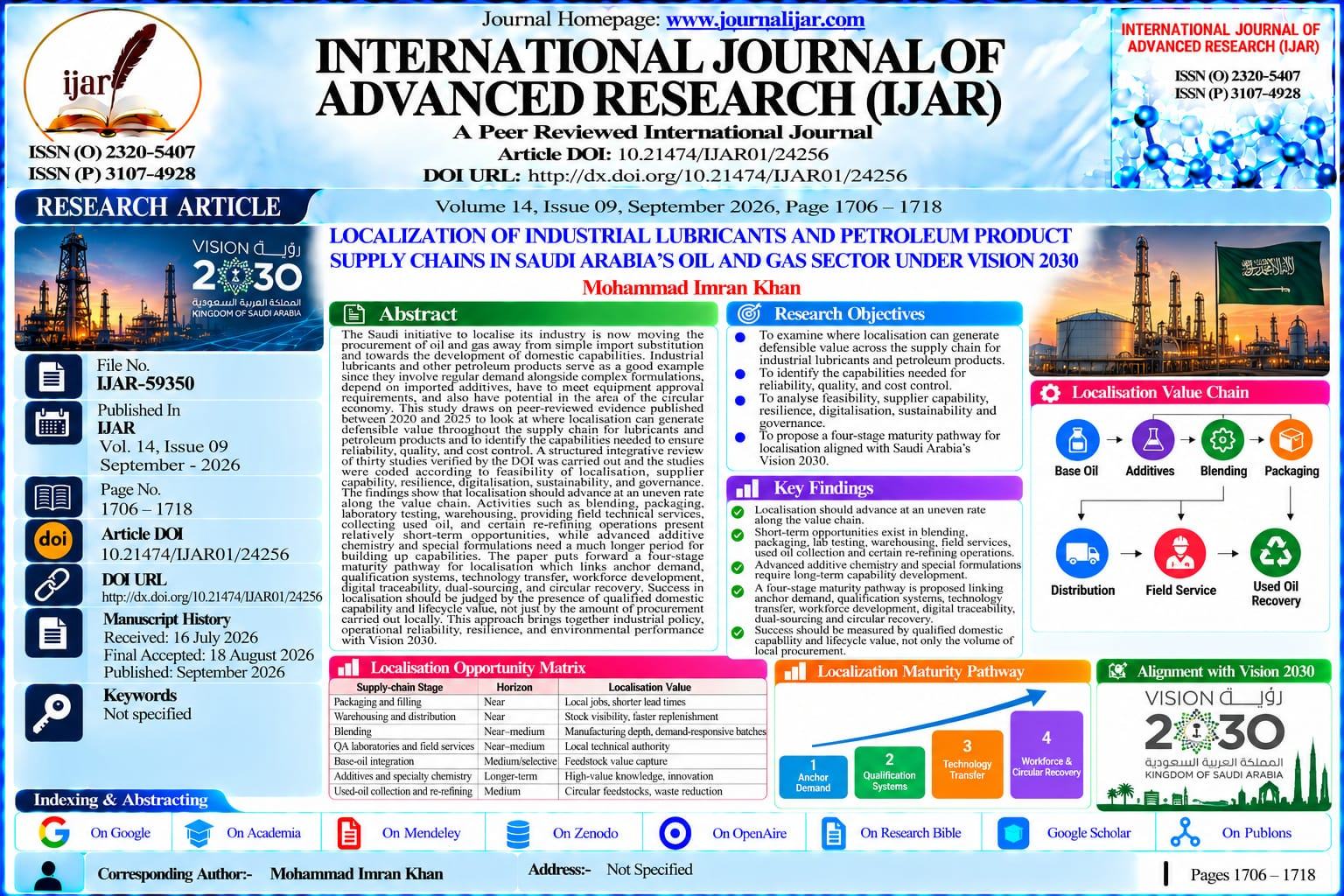
🎉 Proud to contribute to scientific research! Share your publication with your colleagues and professional network.
Article Analytics
 This work is licensed under a Creative Commons Attribution 4.0 International License.