


DIGITAL TWIN-BASED SMART GRID MANAGEMENT FRAMEWORK FOR SUSTAINABLE POWER INFRASTRUCTURE DEVELOPMENT IN SAUDI ARABIA
4 Downloads
168 Views

Abstract
The power industry in Saudi Arabia is undergoing a transformation from a system in which electricity is centrally dispatched and which is based mainly on hydrocarbons to one that is more varied and incorporates utility-scale renewable energy, distributed resources, storage, digital substations, and control systems that demand ever-increasing amounts of data. This change brings with it a management problem because merely expanding the physical grid is not sufficient to guarantee the continuous monitoring, predictive capabilities, coordination between various assets, and the ability to learn over the lifetime that are necessary in a network with a high proportion of renewables. The article examines digital twin technology as a means of managing the sustainable development of power infrastructure in Saudi Arabia. It carries out a systematic and integrated review of peer-reviewed literature published between 2020 and 2025, drawing on evidence from the fields of digital twin architecture, smart-grid operation, renewable energy integration, microgrids, edge intelligence, cybersecurity, asset management, and studies of Saudi Arabias energy transition. The review distinguishes between monitoring replicas and operational twins that are capable of achieving state synchronization, forecasting, scenario testing, and controlled feedback.
How to Cite This Article
Fahad Khan (2026); DIGITAL TWIN-BASED SMART GRID MANAGEMENT FRAMEWORK FOR SUSTAINABLE POWER INFRASTRUCTURE DEVELOPMENT IN SAUDI ARABIA, International Journal of Advanced Research (IJAR), 14 (09), 1719-1731, ISSN 2320-5407. DOI: https://doi.org/10.21474/IJAR01/24257
Corresponding Author
Publication Achievement
Publication card
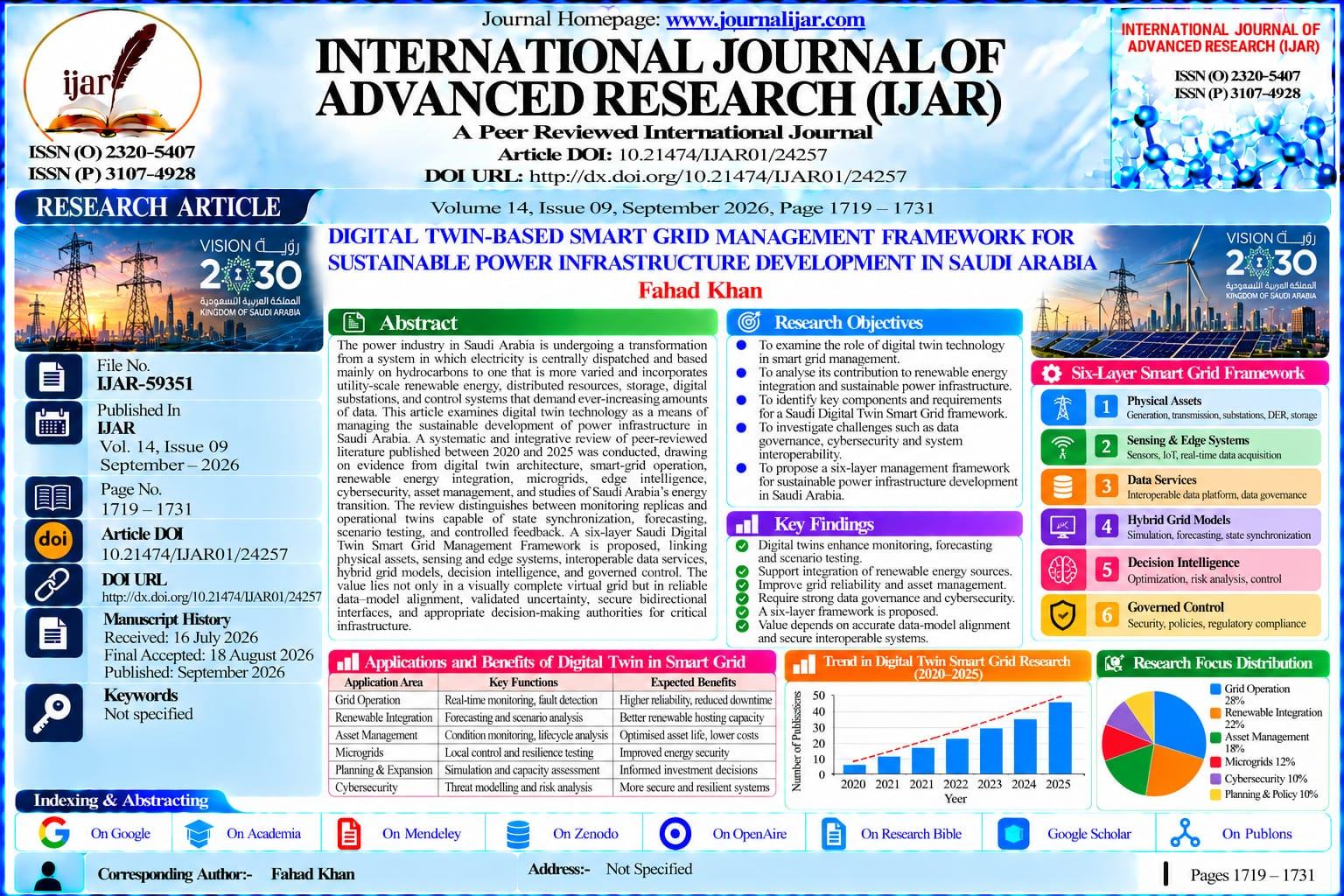
🎉 Proud to contribute to scientific research! Share your publication with your colleagues and professional network.
Article Analytics
 This work is licensed under a Creative Commons Attribution 4.0 International License.