


FINANCIAL RISK MANAGEMENT AND ENTERPRISE RISK GOVERNANCE IN SAUDI ARABIA: STRENGTHENING ORGANIZATIONAL RESILIENCE UNDER VISION 2030
1333 Downloads
10359 Views

Abstract
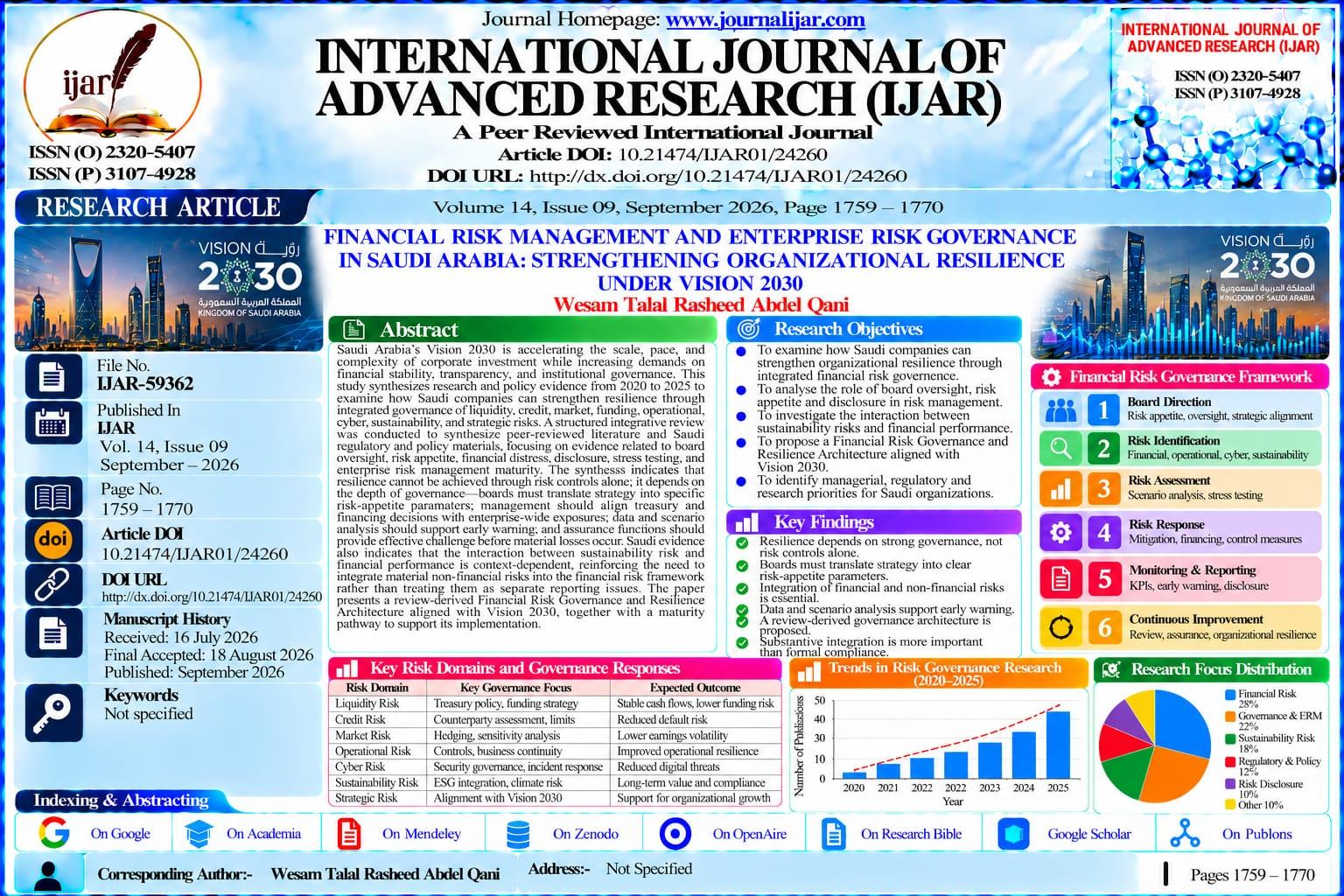
Saudi Arabia’s Vision 2030 is accelerating the scale, pace, and complexity of corporate investment while increasing demands on financial stability, transparency, and institutional governance. This study synthesizes research and policy evidence from 2020 to 2025 to examine how Saudi companies can strengthen resilience through integrated governance of liquidity, credit, market, funding, operational, cyber, sustainability, and strategic risks. A structured integrative review was conducted to synthesize peer-reviewed literature and Saudi regulatory and policy materials, focusing on evidence related to board oversight, risk appetite, financial distress, disclosure, stress testing, and enterprise risk management maturity. The synthesis indicates that resilience cannot be achieved through risk controls alone; it depends on the depth of governanceboards must translate strategy into specific risk-appetite parameters; management should align treasury and financing decisions with enterprise-wide exposures; data and scenario analysis should support early warning; and assurance functions should provide effective challenge before material losses occur. Saudi evidence also indicates that the interaction between sustainability risk and financial performance is context-dependent, reinforcing the need to integrate material non-financial risks into the financial risk framework rather than treating them as separate reporting issues.
How to Cite This Article
Wesam Talal Rasheed Abdel Qani (2026); FINANCIAL RISK MANAGEMENT AND ENTERPRISE RISK GOVERNANCE IN SAUDI ARABIA: STRENGTHENING ORGANIZATIONAL RESILIENCE UNDER VISION 2030, International Journal of Advanced Research (IJAR), 14 (09), 1759-1770, ISSN 2320-5407. DOI: https://doi.org/10.21474/IJAR01/24260
Corresponding Author
Publication Achievement
Publication card
🎉 Proud to contribute to scientific research! Share your publication with your colleagues and professional network.
Article Analytics
 This work is licensed under a Creative Commons Attribution 4.0 International License.