


AI-ENABLED PROACTIVE SAFETY INTERVENTION IN OIL & GAS AND CONSTRUCTION PROJECTS: A HUMAN-SUPERVISED PREDICTIVE RISK REVIEW
0 Downloads
3 Views
Abstract
Artificial intelligence is rapidly entering construction and oil and gas safety management through computer vision, predictive modelling, natural-language processing, digital twins and sensor analytics. Yet predictive accuracy is not equivalent to safety improvement. This review examines how AI-enabled information can become a defensible safety intervention rather than a parallel technology program. A structured integrative review of peer-reviewed literature published from 2020 to 2025 was conducted across construction safety, upstream and pipeline operations, asset integrity and digital risk management. The analysis focuses on four questions: what safety states can be predicted reliably, how predictions should be validated, how human judgement and authority should be retained, and what organizational conditions determine whether warnings produce risk reduction. Evidence is strongest for visual hazard recognition, injury-pattern classification, PPE and proximity monitoring, predictive maintenance, pipeline integrity and data-supported risk estimation. Important limitations persist in data quality, class imbalance, explainability, model drift, sensor failure, transfer across sites, privacy and automation bias.
How to Cite This Article
Rafiullah Khan (2026); AI-ENABLED PROACTIVE SAFETY INTERVENTION IN OIL & GAS AND CONSTRUCTION PROJECTS: A HUMAN-SUPERVISED PREDICTIVE RISK REVIEW, International Journal of Advanced Research (IJAR), 14 (10), 772-782, ISSN 2320-5407.
Corresponding Author
Publication Achievement
Publication card
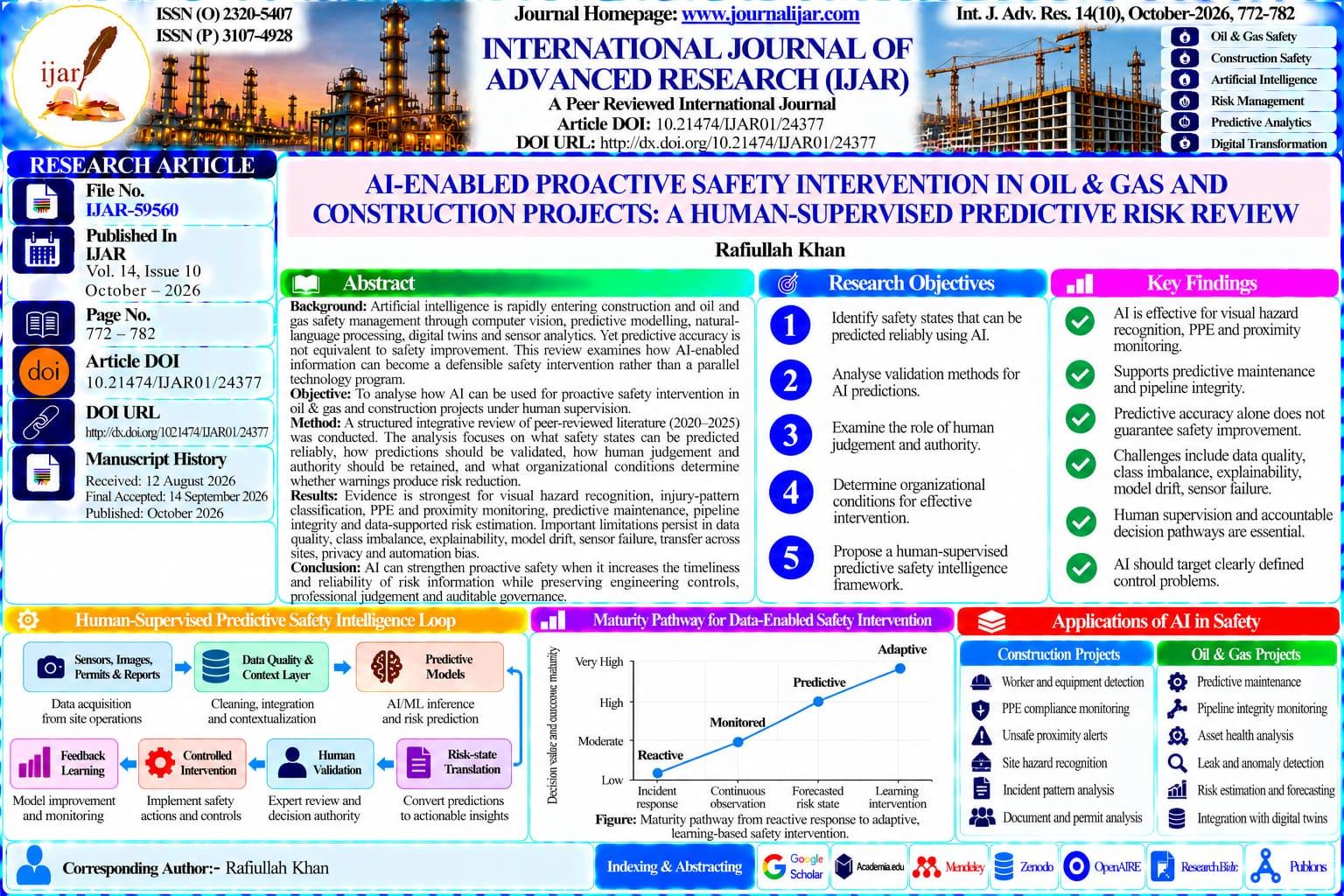
🎉 Proud to contribute to scientific research! Share your publication with your colleagues and professional network.
Article Analytics
 This work is licensed under a Creative Commons Attribution 4.0 International License.