


TOWARDS TRUSTWORTHY EXPLAINABLE AI FOR TOMATO LEAF CLASSIFICATION: A FIDELITY AND STABILITY ANALYSIS OF GRAD-CAM AND LIME
- Universite Numerique Cheikh Hamidou Kane, Dakar, Senegal.
- Universite Iba Der THIAM de Thies, Thies, Senegal.
3 Downloads
239 Views

Abstract
Deep learning models achieve state-of-the-art performance in automatic plant disease classification; however, their decision opacity remains a major barrier to adoption in high-stakes agricultural applications. Indeed, trust from agronomy experts depends directly on the ability of these systems to provide reliable and interpretable justifications for their predictions. In this work, we present an evaluation of two post-hoc explainability methods, Grad CAM and LIME, applied to an EfficientNetV2B3 model trained on a tomato leaf image dataset. The analysis combines a qualitative assessment of activation maps and explanatory masks with a quantitative evaluation based on DAUC and IAUC metrics,complemented by a stability analysis under input perturbations. The results reveal a trade-off between fidelity and stability of explanations. LIME achieves higher fidelity according to insertion and deletion metrics (IAUC = 0.9268, DAUC = 0.4187), whereas Grad-CAM provides more stable explanations (0.0002 vs. 0.0025). Qualitative analyses further show that both methods highlight disease-relevant agronomic symptoms. These findings underscore the complementarity of Grad-CAM and LIME for explainability. Grad-CAM facilitates the localization of disease-relevant regions, whereas LIME provides a more detailed characterization of the influential pixels within those regions. Together, they offer a coherent and complementary explanatory framework that strengthens the overall explainability of the model.
Keywords
How to Cite This Article
Donatien Gueswende Kabore et, al (2026); TOWARDS TRUSTWORTHY EXPLAINABLE AI FOR TOMATO LEAF CLASSIFICATION: A FIDELITY AND STABILITY ANALYSIS OF GRAD-CAM AND LIME, International Journal of Advanced Research (IJAR), 14 (07), 30-42, ISSN 2320-5407. DOI: https://doi.org/10.21474/IJAR01/23763
Corresponding Author
Publication Achievement
Publication card
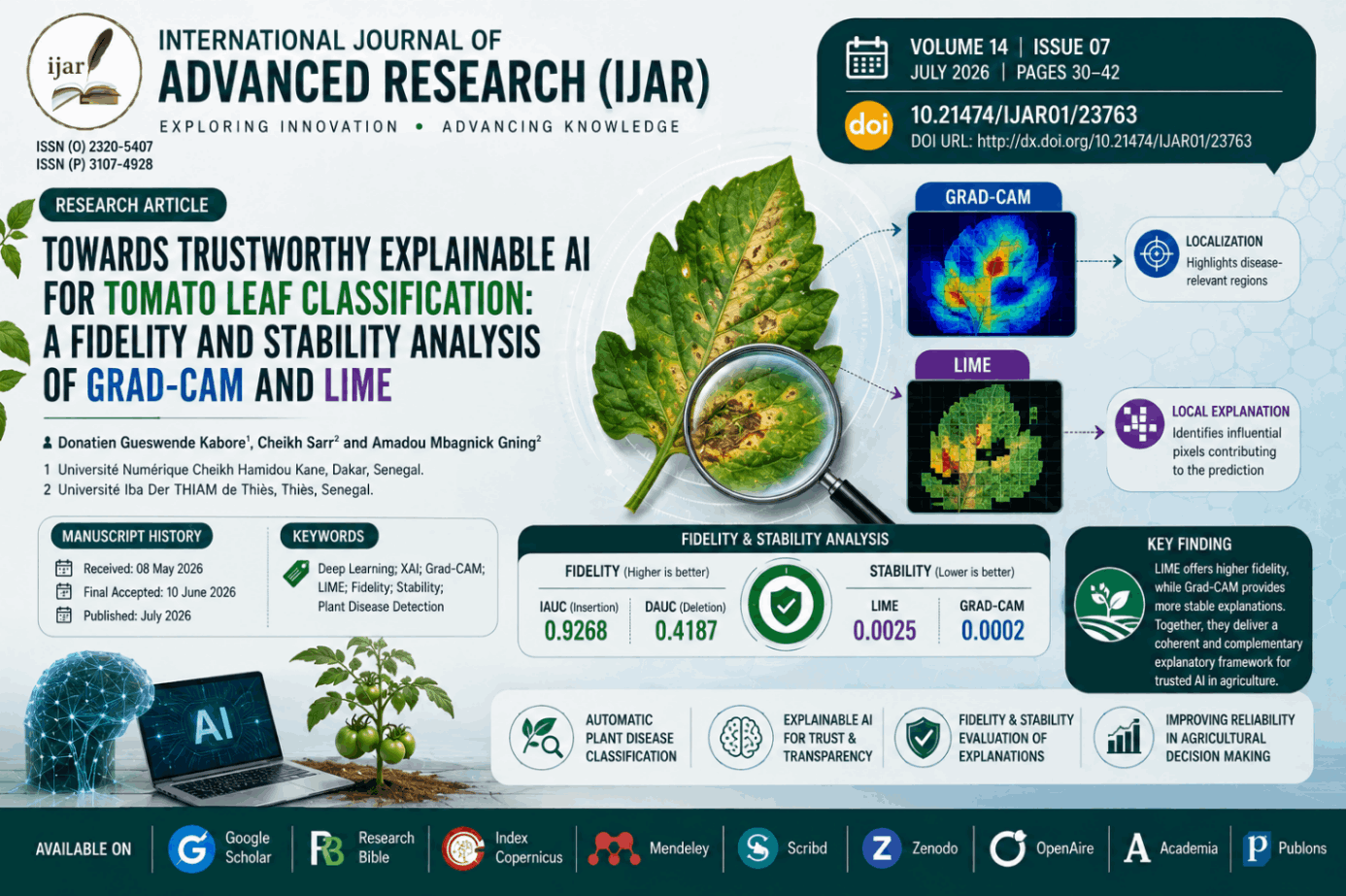
🎉 Proud to contribute to scientific research! Share your publication with your colleagues and professional network.
Article Analytics
Similar Articles
8
201
260
889
3
66
1
103
42
439
 This work is licensed under a Creative Commons Attribution 4.0 International License.