


ROLE OF EMOTIONAL INTELLIGENCE IN CRIME PREVENTION: AN AYURVEDIC PERSPECTIVE ON BEHAVIORAL AND MENTAL HEALTH
0 Downloads
207 Views

Abstract
Crime is a complex global concern with important social and public health implications. The rising burden of violence, substance misuse, cyber offenses, juvenile delinquency, and interpersonal conflict suggests deeper disturbances in emotional regulation and behavioral control. Emotional intelligence, which refers to the ability to recognize, interpret, manage, and apply emotions effectively, is increasingly recognized as a factor that supports prosocial conduct and may help reduce criminal behavior. Individuals with weaker emotional regulation are often more vulnerable to impulsive reactions, aggression, antisocial conduct, and other forms of harmful behavior. In Ayurveda, mental well-being is understood through principles such as Satva, Raja, Tama, Prajnaparadha, and Sadvritta, which together emphasize psychological balance, ethical discipline, and self-regulation. This review examines how emotional intelligence, and criminal behavior may be related and considers how Ayurvedic principles can contribute to emotional stability, moral development, and social harmony. Integrating emotional intelligence education with Ayurvedic lifestyle practices and psychological support may provide a preventive approach to reducing crime and improving mental well-being.
Keywords
How to Cite This Article
Dr Manvi Laxmikant Madkam (2026); ROLE OF EMOTIONAL INTELLIGENCE IN CRIME PREVENTION: AN AYURVEDIC PERSPECTIVE ON BEHAVIORAL AND MENTAL HEALTH, International Journal of Advanced Research (IJAR), 14 (07), 1198-1205, ISSN 2320-5407. DOI: https://doi.org/10.21474/IJAR01/23869
Corresponding Author
Publication Achievement
Publication card
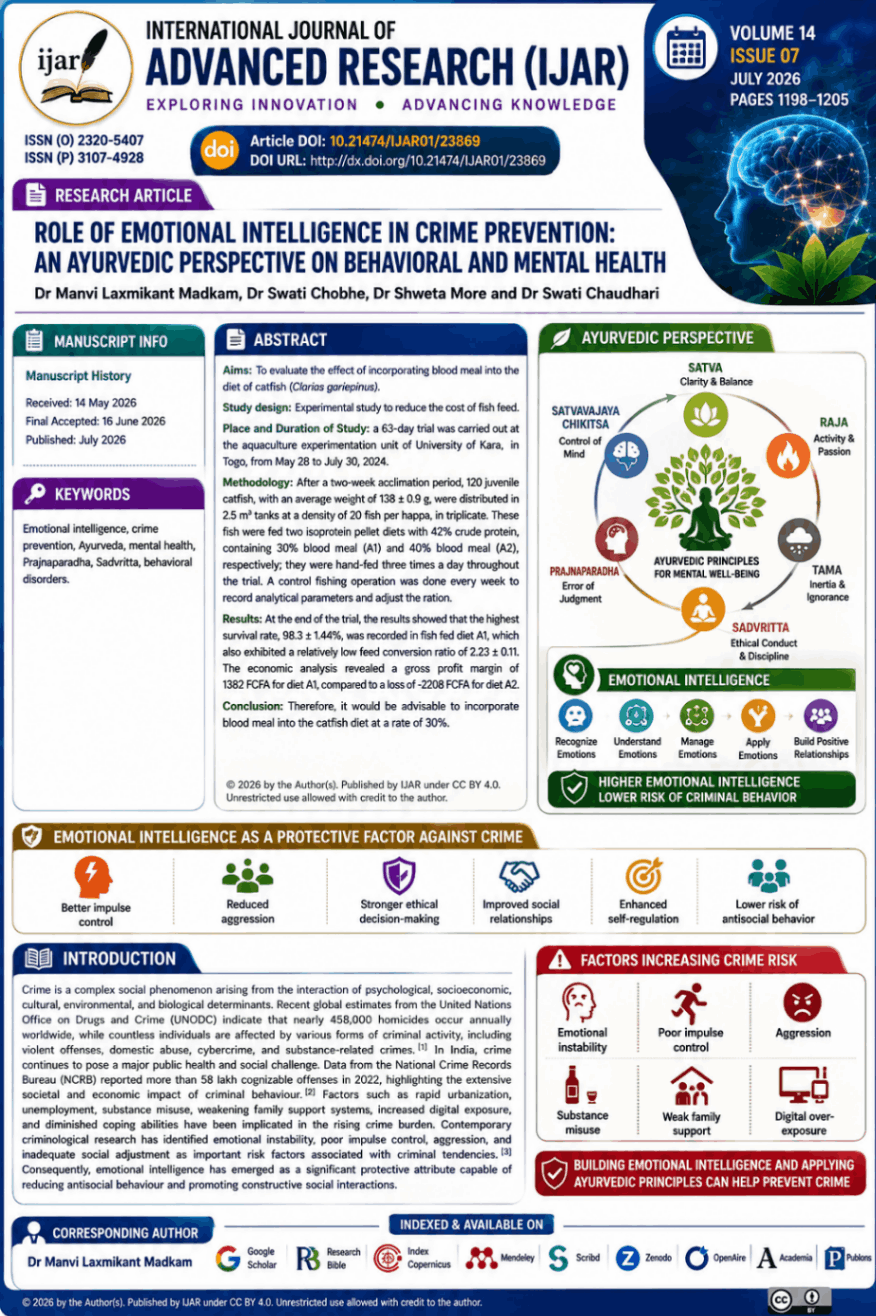
🎉 Proud to contribute to scientific research! Share your publication with your colleagues and professional network.
Article Analytics
Similar Articles
22
492
7
293
0
255
2
159
41
296
 This work is licensed under a Creative Commons Attribution 4.0 International License.