


ANALYTICAL OPTIMIZATION OF THE BASE THICKNESS OF A FRONT-ILLUMINATED (N/P/P) BIFACIAL SILICON SOLAR CELL UNDER COMBINED EFFECTS OF TEMPERATURE, FREQUENCY MODULATION, IRRADIATION AND DAMAGE COEFFICIENT
- Universite Iba Der THIAM de Thies, Senegal.
- Faculte des Sciences et Technologies de l Education et de la Formation-Departement de Physique et Chimie, Universite Cheikh Anta DIOP, Dakar-Senegal.
1 Downloads
189 Views

Abstract
Optimizing the base thickness is a key challenge for improving the performance of bifacial silicon solar cells, particularly when they are designed to operate under combined thermal, radiation, and dynamic conditions. In this work, an original analytical approach based on the derivative of the back surface recombination velocity of minority carriers is proposed to determine the optimum base thickness of a front-illuminated bifacial silicon solar cell with an (n+/p/p+) structure under polychromatic light modulated in frequency. The developed model simultaneously accounts for the effects of temperature, modulation frequency, irradiation energy, and the damage coefficient on minority carrier transport. This approach establishes a relationship between the diffusion, generation, and recombination mechanisms and the evolution of the optimum base thickness under realistic operating conditions.
Keywords
How to Cite This Article
Mohamed Yahya Teyah et, al (2026); ANALYTICAL OPTIMIZATION OF THE BASE THICKNESS OF A FRONT-ILLUMINATED (N/P/P) BIFACIAL SILICON SOLAR CELL UNDER COMBINED EFFECTS OF TEMPERATURE, FREQUENCY MODULATION, IRRADIATION AND DAMAGE COEFFICIENT, International Journal of Advanced Research (IJAR), 14 (07), 1585-1598, ISSN 2320-5407. DOI: https://doi.org/10.21474/IJAR01/23904
Corresponding Author
Publication Achievement
Publication card
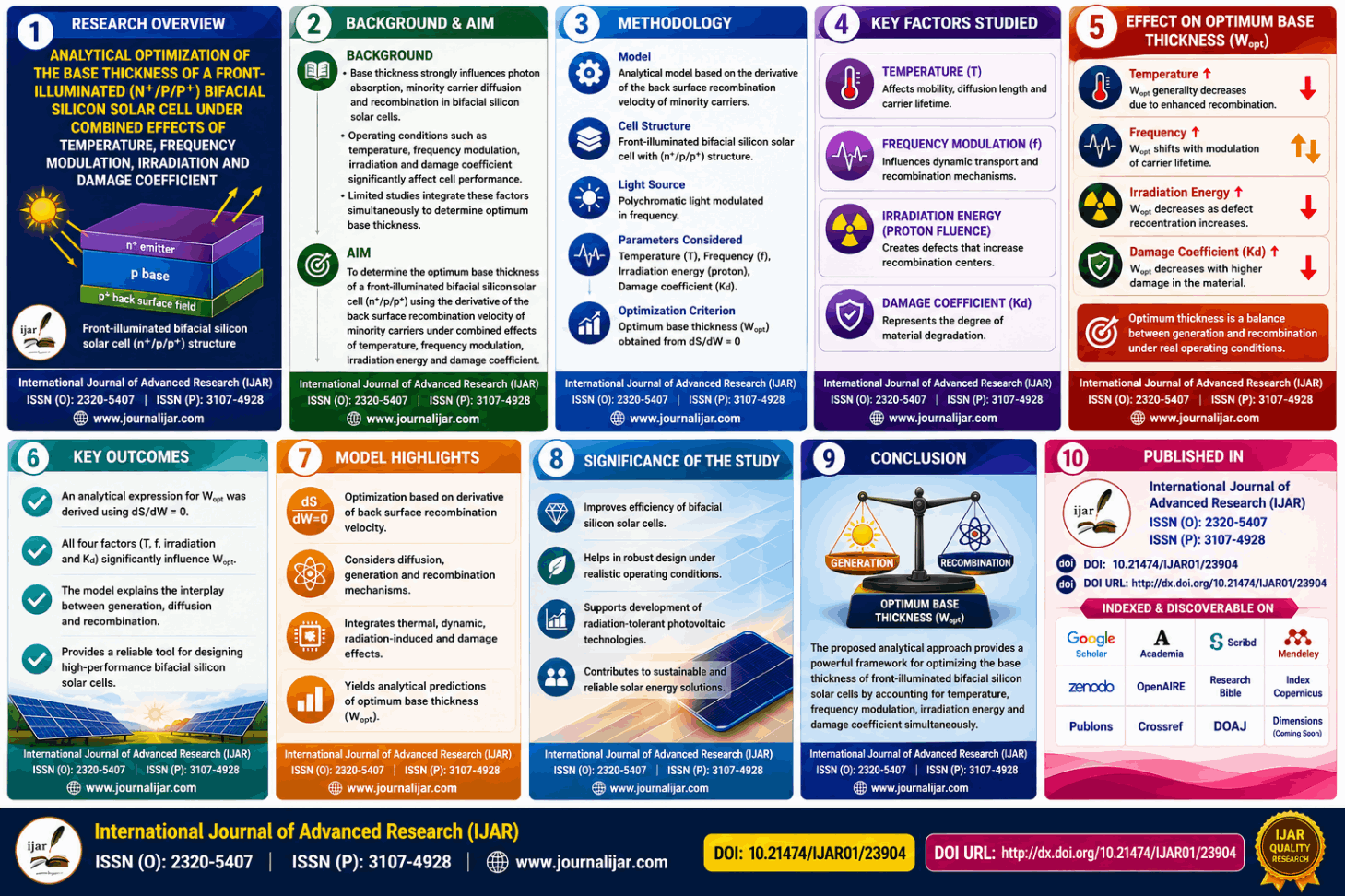
🎉 Proud to contribute to scientific research! Share your publication with your colleagues and professional network.
Article Analytics
Similar Articles
4
201
5
267
11
219
6
231
14
252
 This work is licensed under a Creative Commons Attribution 4.0 International License.