


EFFECT OF BLADE-ALIGNED CASING TREATMENT SLOTS ON PERFORMANCE OF A TRANSONIC COMPRESSOR ROTOR
- Faculty of Engineering & Technology, Department of Electrical Engineering, Department Aerospace and Automotive Engineering.
- M S Ramaiah University of Applied Sciences, Bangalore, Karnataka, India.
3 Downloads
192 Views

Abstract
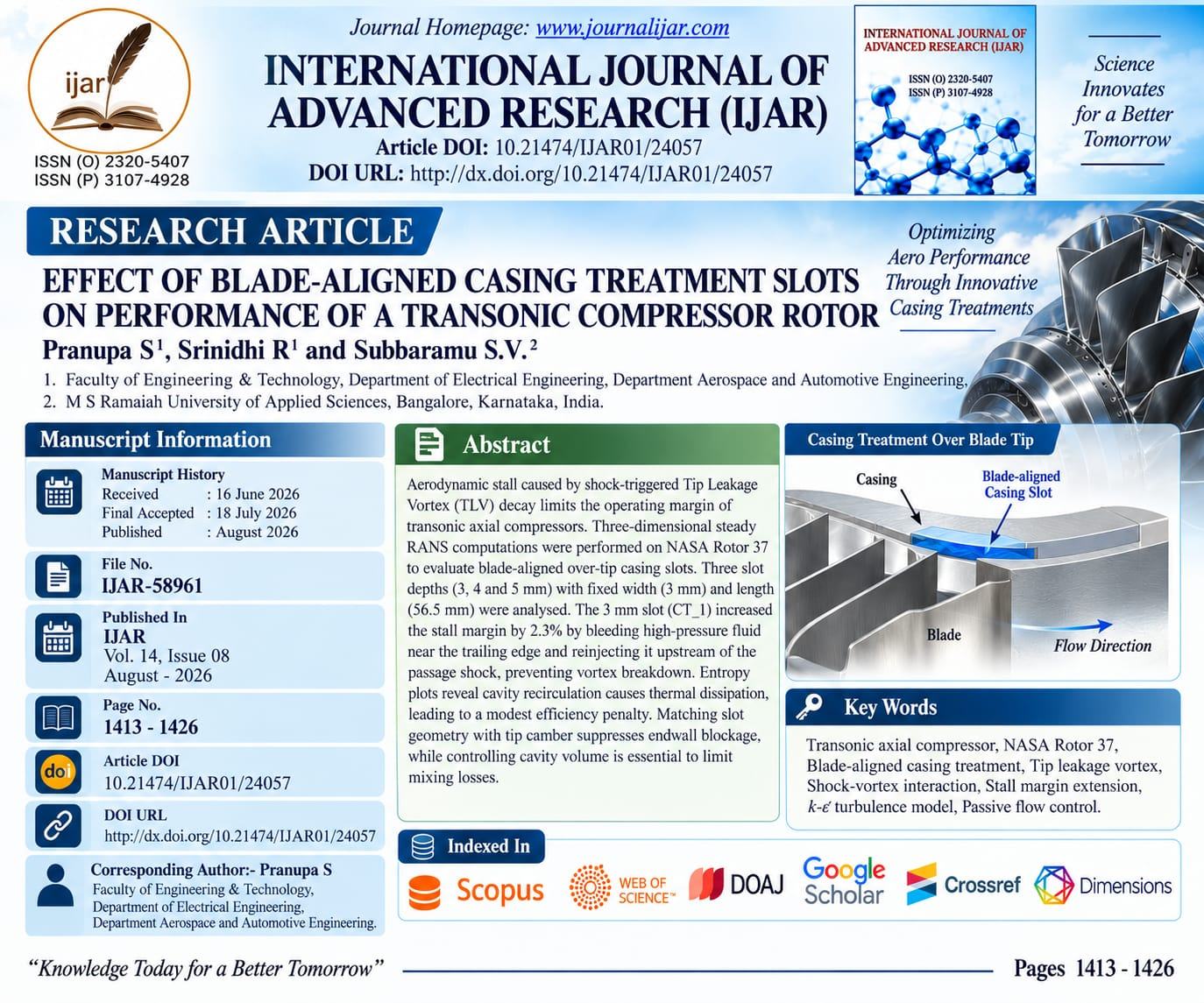
Aerodynamic stall caused by shock-triggered Tip Leakage Vortex (TLV)decay severely restricts the operating margin of transonic axial compressors and accelerates stall onset. To alleviate this boundary layer phenomenon, three-dimensional steady Reynolds-Averaged Navier-Stokes (RANS) computations were performed on an isolated NASA Rotor 37 geometry to evaluate passive flow mitigation using blade-aligned, over-tip casing slots. Performance on a standard smooth shroud was benchmarked against three slot configurations varying in depth 3mm, 4 mm, and 5) while maintaining a fixed width of 3mm and length of 56.5 mm, using a validated multi-block structured mesh (1.22 10^6 elements). The 3 mm slot depth variant (CT_1) expanded the stall margin by 2.3 through bleeding high-pressure fluid near the trailing edge and reinjecting it ahead of the passage shock to prevent vortex breakdown.Entropy visualizations indicate thatinternal cavity recirculation generates shear-driven thermal dissipation, incurring a modest peak efficiency penalty across all slotted models. While matching slot geometry with tip camber effectively suppresses end wall flow blockage, controlling cavity volume remains essential to limit internal mixing losses.
Keywords
How to Cite This Article
Pranupa S et, al (2026); EFFECT OF BLADE-ALIGNED CASING TREATMENT SLOTS ON PERFORMANCE OF A TRANSONIC COMPRESSOR ROTOR, International Journal of Advanced Research (IJAR), 14 (08), 1413-1426, ISSN 2320-5407. DOI: https://doi.org/10.21474/IJAR01/24057
Corresponding Author
Publication Achievement
Publication card
🎉 Proud to contribute to scientific research! Share your publication with your colleagues and professional network.
Article Analytics
 This work is licensed under a Creative Commons Attribution 4.0 International License.