


ENERGY-EFFICIENT DESIGN AND PERFORMANCE OPTIMIZATION OF PRESSURE VESSELS AND PROCESS EQUIPMENT IN SAUDI OIL AND GAS FACILITIES
6 Downloads
220 Views

Abstract
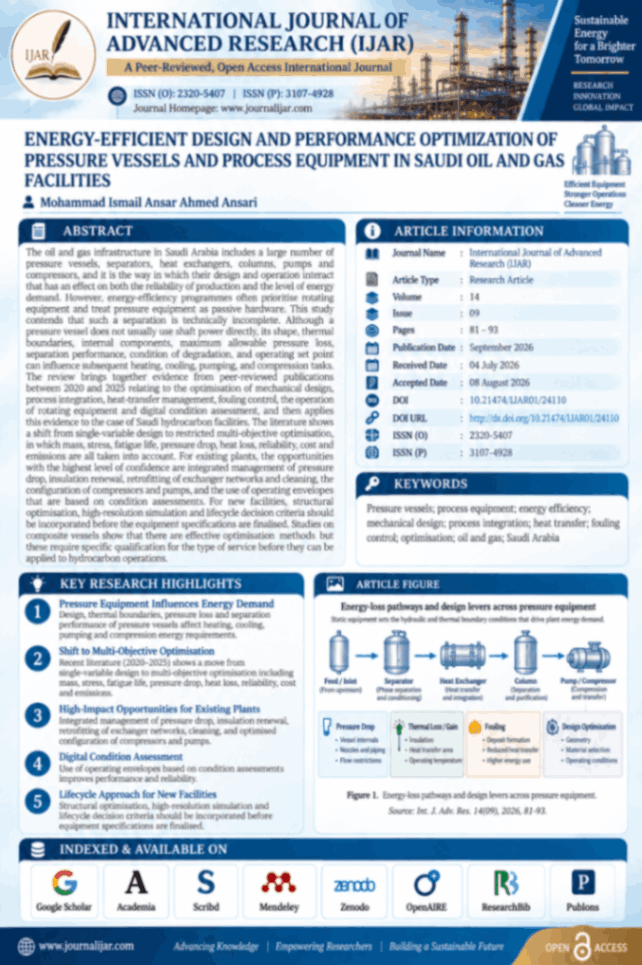
The oil and gas infrastructure in Saudi Arabia includes a large number of pressure vessels, separators, heat exchangers, columns, pumps and compressors, and it is the way in which their design and operation interact that has an effect on both the reliability of production and the level of energy demand. However, energy-efficiency programmes often prioritise rotating equipment and treat pressure equipment as passive hardware. This study contends that such a separation is technically incomplete. Although a pressure vessel does not usually use shaft power directly, its shape, thermal boundaries, internal components, maximum allowable pressure loss, separation performance, condition of degradation, and operating set point can influence subsequent heating, cooling, pumping, and compression tasks. The review brings together evidence from peer-reviewed publications between 2020 and 2025 relating to the optimisation of mechanical design, process integration, heat-transfer management, fouling control, the operation of rotating equipment and digital condition assessment, and then applies this evidence to the case of Saudi hydrocarbon facilities. The literature shows a shift from single-variable design to restricted multi-objective optimisation, in which mass, stress, fatigue life, pressure drop, heat loss, reliability, cost and emissions are all taken into account. For existing plants, the opportunities with the highest level of confidence are integrated management of pressure drop, insulation renewal, retrofitting of exchanger networks and cleaning, the configuration of compressors and pumps, and the use of operating envelopes that are based on condition assessments.
How to Cite This Article
Mohammad Ismail Ansar Ahmed Ansari (2026); ENERGY-EFFICIENT DESIGN AND PERFORMANCE OPTIMIZATION OF PRESSURE VESSELS AND PROCESS EQUIPMENT IN SAUDI OIL AND GAS FACILITIES, International Journal of Advanced Research (IJAR), 14 (09), 105-116, ISSN 2320-5407. DOI: https://doi.org/10.21474/IJAR01/24112
Corresponding Author
Publication Achievement
Publication card
🎉 Proud to contribute to scientific research! Share your publication with your colleagues and professional network.
Article Analytics
 This work is licensed under a Creative Commons Attribution 4.0 International License.