


FROM PCOS TO PMOS: A CRITICAL REVIEW OF TERMINOLOGY, MULTISYSTEM PATHOLOGY, AND CLINICAL IMPLICATIONS
- EMPROS International School.
17 Downloads
247 Views

Abstract
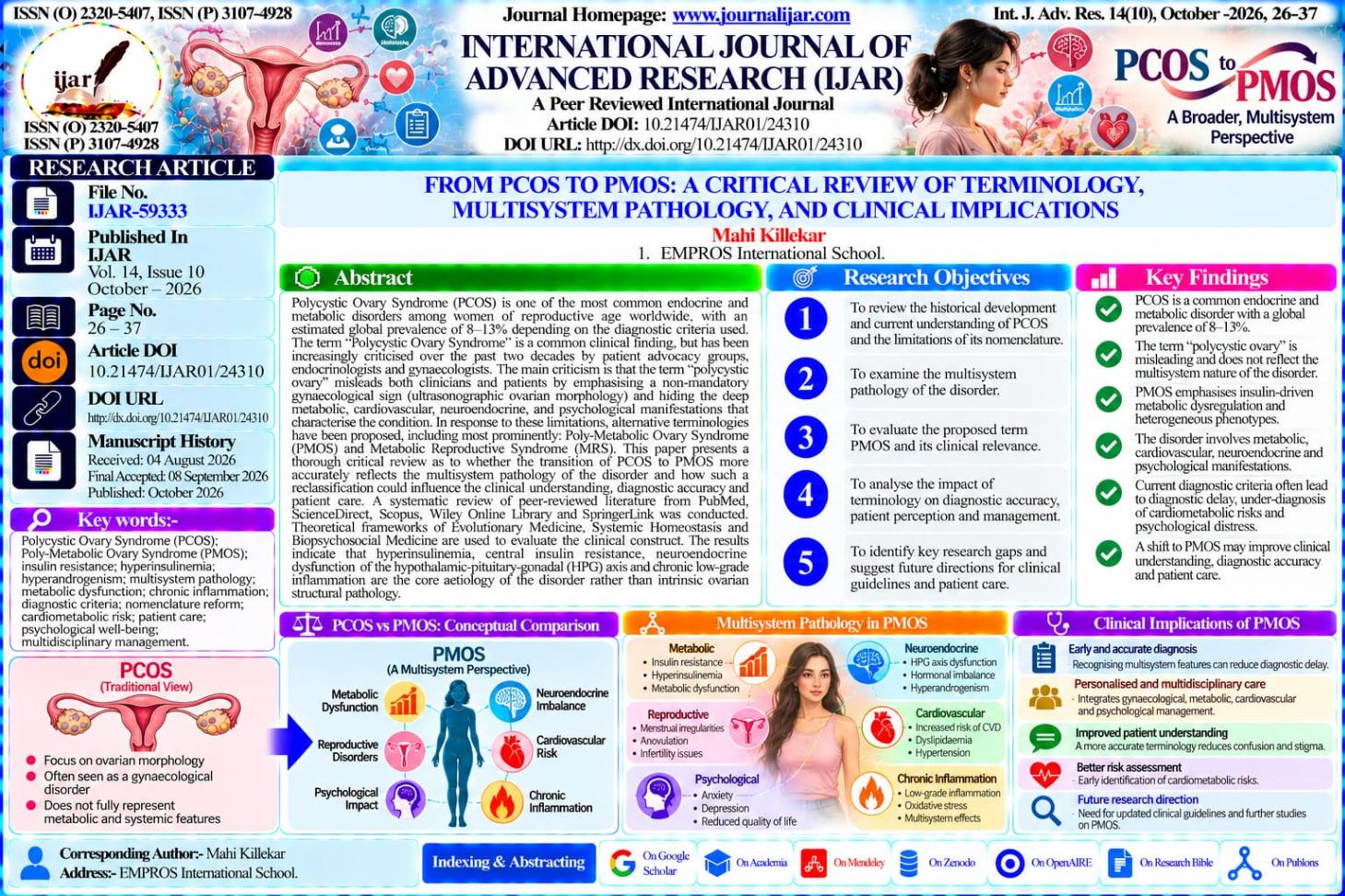
Polycystic Ovary Syndrome (PCOS) is one of the most common endocrine and metabolic disorders among women of reproductive age worldwide, with an estimated global prevalence of 8-13% depending on the diagnostic criteria used. The term Polycystic Ovary Syndrome is a common clinical finding, but has been increasingly criticised over the past two decades by patient advocacy groups, endocrinologists and gynaecologists. The main criticism is that the term polycystic ovary misleads both clinicians and patients by emphasising a non-mandatory gynaecological sign (ultrasonographic ovarian morphology) and hiding the deep metabolic, cardiovascular, neuroendocrine, and psychological manifestations that characterise the condition. In response to these limitations, alternative terminologies have been proposed by clinical researchers, including most prominently: Poly-Metabolic Ovary Syndrome (PMOS) and Metabolic Reproductive Syndrome (MRS). This secondary research paper presents a thorough critical review as to whether the transition of PCOS to PMOS more accurately reflects the multisystem pathology of the disorder and how such a reclassification could influence the clinical understanding, diagnostic accuracy and patient care.
Keywords
How to Cite This Article
Mahi Killekar (2026); FROM PCOS TO PMOS: A CRITICAL REVIEW OF TERMINOLOGY, MULTISYSTEM PATHOLOGY, AND CLINICAL IMPLICATIONS, International Journal of Advanced Research (IJAR), 14 (10), 26-37, ISSN 2320-5407. DOI: https://doi.org/10.21474/IJAR01/24310
Corresponding Author
Publication Achievement
Publication card
🎉 Proud to contribute to scientific research! Share your publication with your colleagues and professional network.
Article Analytics
Similar Articles
11
461
4
304
20
274
20
388
32
814
 This work is licensed under a Creative Commons Attribution 4.0 International License.