


INTEROPERABILITY OF ELECTRONIC HEALTH RECORDS USING HL7 AND FHIR STANDARDS: A FRAMEWORK FOR INTEGRATED HEALTHCARE SYSTEMS IN SAUDI ARABIA
0 Downloads
13 Views
Abstract
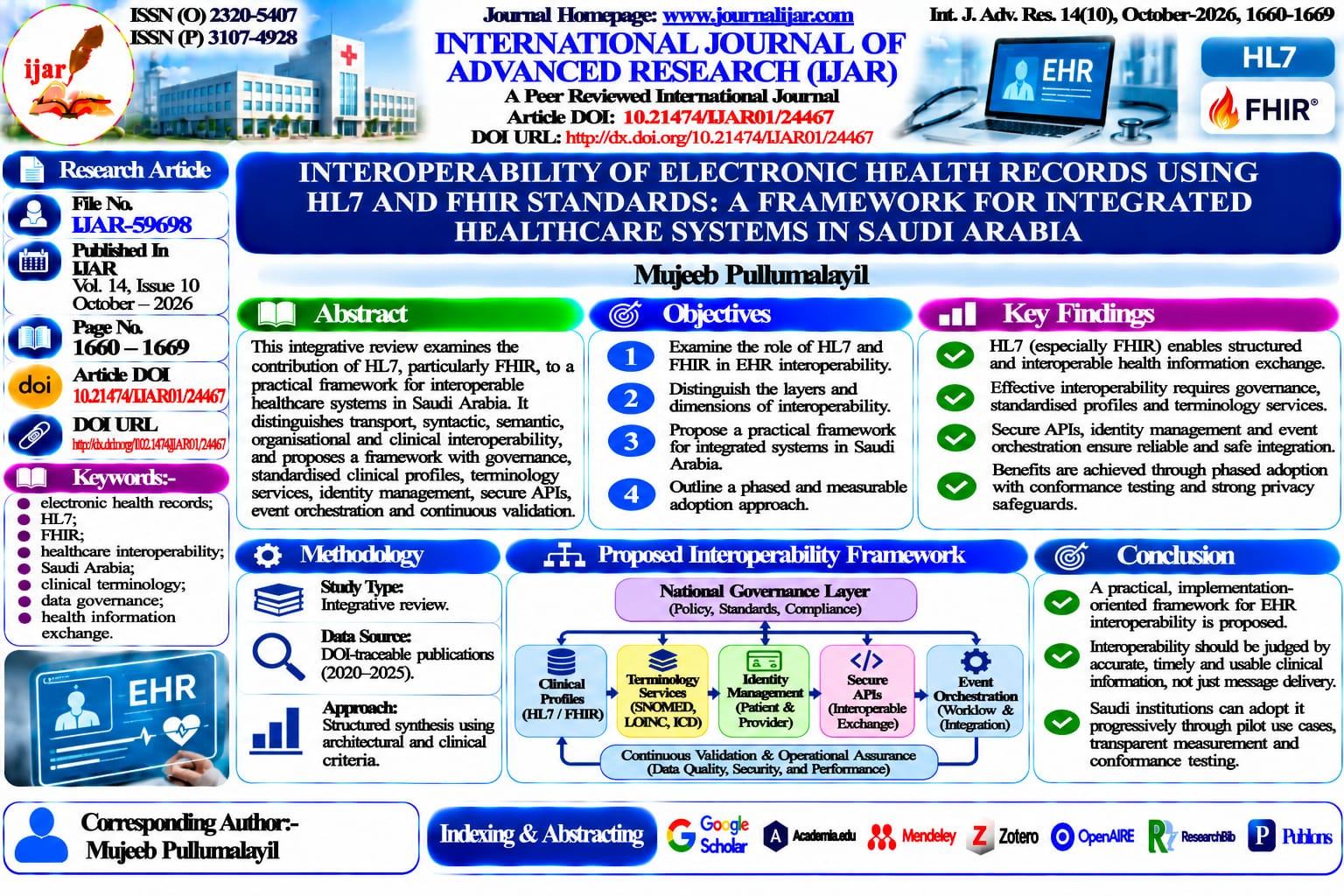
Electronic health records can improve continuity of care only when relevant clinical information follows patients across institutions without losing its meaning, context or security. In Saudi Arabia, the expansion of digital healthcare creates an opportunity to connect hospital information systems, primary care platforms, laboratories, pharmacies, insurers and national exchange services. Yet integration is constrained by legacy interfaces, inconsistent terminologies, patient-matching errors, competing governance arrangements and uneven technical capability. This integrative review examines the contribution of Health Level Seven standards, particularly Fast Healthcare Interoperability Resources, to a practical framework for integrated healthcare systems. It distinguishes transport connectivity from syntactic, semantic, organisational and clinical interoperability, and analyses architecture, implementation guidance, information governance and operational assurance. The proposed framework combines a national governance layer, standardised clinical profiles, terminology services, identity management, secure application programming interfaces, event orchestration and continuous validation.
Keywords
How to Cite This Article
Mujeeb Pullumalayil (2026); INTEROPERABILITY OF ELECTRONIC HEALTH RECORDS USING HL7 AND FHIR STANDARDS: A FRAMEWORK FOR INTEGRATED HEALTHCARE SYSTEMS IN SAUDI ARABIA, International Journal of Advanced Research (IJAR), 14 (10), 1660-1669, ISSN 2320-5407.
Corresponding Author
Publication Achievement
Publication card
🎉 Proud to contribute to scientific research! Share your publication with your colleagues and professional network.
Article Analytics
Similar Articles
2
322
0
34
0
14
0
10
2
98
 This work is licensed under a Creative Commons Attribution 4.0 International License.