


AGENTIC AI FOR END-TO-END AUTOMATION OF THE DATA QUALITY LIFECYCLE: A DAMA- AND NDMO-ALIGNED GOVERNANCE FRAMEWORK FOR SAUDI ENTERPRISES
2 Downloads
228 Views

Abstract
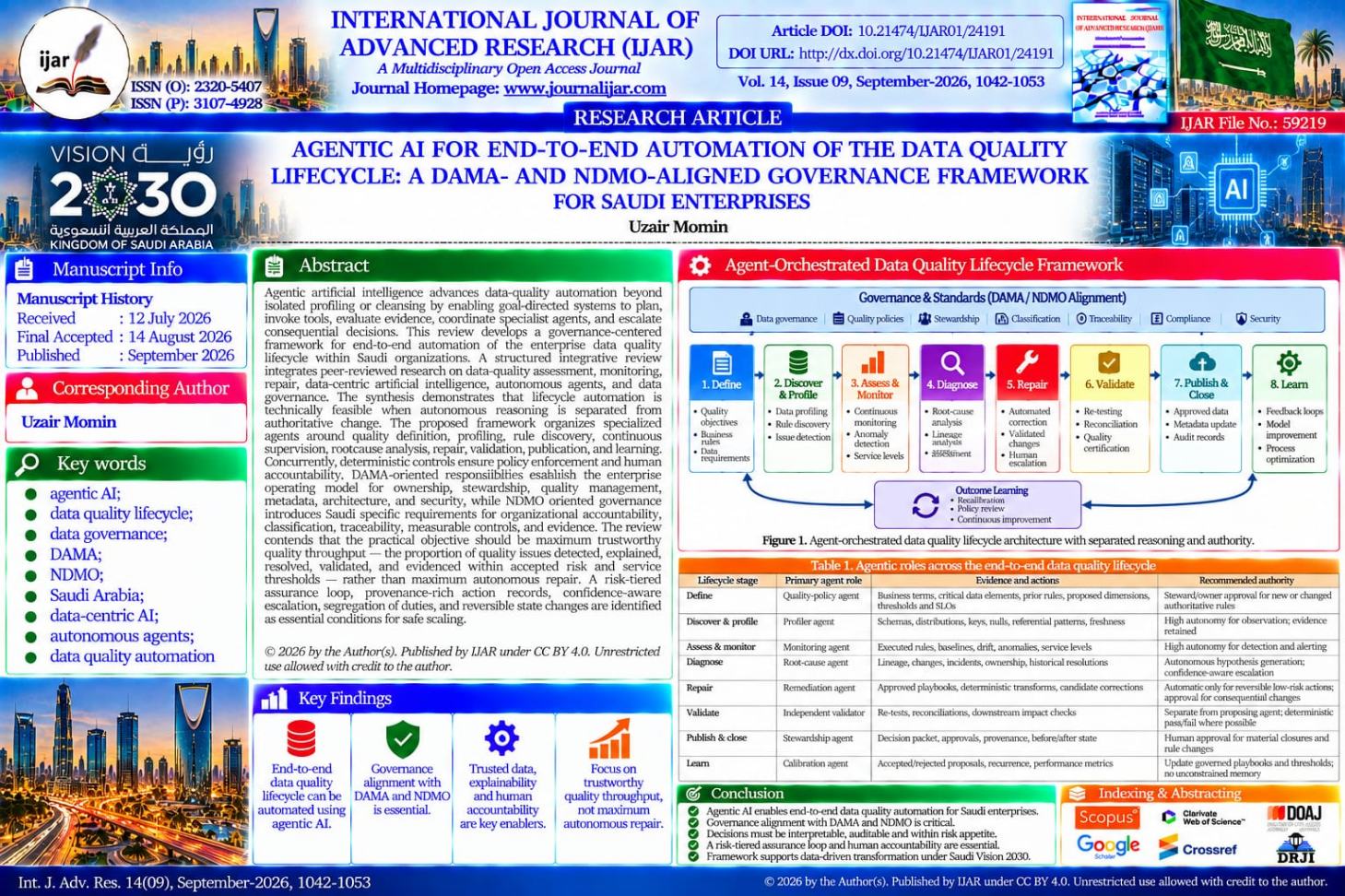
Agentic artificial intelligence advances data-quality automation beyond isolated profiling or cleansing by enabling goal-directed systems to plan, invoke tools, evaluate evidence, coordinate specialist agents, and escalate consequential decisions. This review develops a governance-centered framework for end-to-end automation of the enterprise data quality lifecycle within Saudi organizations. A structured integrative review integrates peer-reviewed research on data-quality assessment, monitoring, repair, data-centric artificial intelligence, autonomous agents, and data governance. The synthesis demonstrates that lifecycle automation is technically feasible when autonomous reasoning is separated from authoritative change. The proposed framework organizes specialized agents around quality definition, profiling, rule discovery,continuous supervision, rootcause analysis, repair,validation, publication, and learning. Concurrently, deterministic controls ensure policy enforcement and human accountability. DAMA-oriented responsibilities establish the enterprise operating model for ownership, stewardship, quality management, metadata, architecture, and security, while NDMO oriented governance introduces Saudi specific requirements for organizational accountability, classification, traceability, measurable controls, and evidence.
Keywords
How to Cite This Article
Uzair Momin (2026); AGENTIC AI FOR END-TO-END AUTOMATION OF THE DATA QUALITY LIFECYCLE: A DAMA- AND NDMO-ALIGNED GOVERNANCE FRAMEWORK FOR SAUDI ENTERPRISES, International Journal of Advanced Research (IJAR), 14 (09), 1042-1053, ISSN 2320-5407. DOI: https://doi.org/10.21474/IJAR01/24191
Corresponding Author
Publication Achievement
Publication card
🎉 Proud to contribute to scientific research! Share your publication with your colleagues and professional network.
Article Analytics
Similar Articles
0
36
0
51
1
43
3
110
1
106
 This work is licensed under a Creative Commons Attribution 4.0 International License.